Thursday, March 28, 2024

The wistful musings of a reluctant émigré by Nihal D Amerasekera

The wistful musings of a reluctant émigré

By Dr Nihal D Amerasekera

It has been a cold and wet winter in London. As I snuggle-up in my rocking chair to write my thoughts I can hear the wind howling outside. The raindrops are carried horizontally by the strong south-westerly wind battering the window panes and dripping down in torrents.

I still have grateful memories of a happy 12 years at Wesley College. The school on Karlsruhe Hill was established with missionary zeal and some colonial vigour but it catered for all Ceylonese. The school became the cradle of multiculturalism. Protected from the polarised world outside, it remained secular and was driven by merit. Since the very beginning, Wesley has strived hard to become a modern, forward-thinking school. The school has a strong record of academic achievements and a full programme of wider life activities, including the arts and sports.

The school’s sesquicentennial anniversary has come and gone. One hundred and fifty years of life of a school is a huge achievement in this era of survival of the fittest. Longevity arises partly from good fortune but mostly from sustained effort. I left school in April 1962 to seek that elusive fame and fortune. They both have eluded me since!!

I was unable to attend any of the functions and events of this great occasion. Living in London, the journey, including a long flight, was too arduous to attempt. Age-related infirmities have caught up with me. I have done the next best thing, to watch on social media the unfolding of a prodigious chain of events. There weren’t many from my generation present as some have departed this world. The dinners and dances were vibrant, colourful and full of fun. The young enjoyed it to their hearts content. Many of my contemporaries boogied the night away taking longer breaks to catch their breath. There is a message in all this. Do what you can when you are fit and able.

The camaraderie was there for all to see with smaller reunions and gatherings prior to the main dinner and dance at the Shangri-La Hotel. When old boys come together, they move into recollection mode, recalling those beautiful, quirky moments of their youth. There is never a dull moment. Voices are imitated, mannerisms mimicked, and idiosyncrasies enhanced. Long forgotten episodes of school life suddenly spring to mind, bringing laughter, affection, and sadness. As the wine and conversation flowed, they are transported back many decades bringing forth those warm feelings of the lost years. The last to leave often provided a lusty rendition of the old school song.

We spend our formative and impressionable years at school. It has created an Aladdin's cave of wondrous memories. The sands of time have moved on as I have progressed from youth to middle age and beyond. Those memories of friends and fun seemed to be stored and archived to last a lifetime. The stored memories resurface each time I visit the old school and walk the long corridors again. The Great Hall is a remarkable place for nostalgia. When I sit in silence beneath the high teak ceiling surrounded by gorgeous Victorian stained-glass windows, the school song seems to resonate in the distance. It is not easy to hold back the tears. The intensity of the occasion is often overwhelming. As I live so far away beyond the horizon, this for me is a special treat.

It was cricket that unified us all. Playing and watching the game was one of the most enjoyable things of my time at Wesley. A tangle of emotions tumble through my mind as I reflect on watching cricket under the mara trees at Campbell Park. For the students at Wesley College, Campbell Park has been the cradle of all sports. But the school has never owned the park. It is on a short lease reluctantly extended, each time, by the Colombo Municipal Council. During the Anniversary Dinner at the Shangri-la, successive speakers pleaded with the President of Sri Lanka, who was an honoured guest, to handover the park to the school. It is true these are not issues that could be resolved over dinner. The promise was to say “I will see what I can do”. However, we can but dream of a good outcome.

We all hate change and often hear the laments "the school is not what it used to be" or “It is not as good as it was”. This is more a nostalgic vision of a mystical, non-existent past. Schools are places of endemic change. Every year new students join and those who have left go farther on life's journey outside the school gates. We must change with time. The school has changed and have done so maintaining our links with our glorious past. We have kept the old traditions whilst embracing the innovative and modern. Rejuvenation and modernisation are a continuous process. It would be dismissive to say that the changes thus far have procured no benefit.

Since my time the landscape surrounding the school too has changed beyond recognition. The narrow Baseline road of my day of Morris Minor cabs and red Leyland buses has given way to a busy dual carriageway of faster traffic. The view of the Welikada Prison and its perimeter fence seem to be unchanged. Being so close to the prison for over a decade I had often peered into the distance allowing my mind to wander inside. For many of us the prison is a dark and mysterious place. Very few knew what happened behind those grim iron gates. To us the inmates were criminals, desperate and dangerous. Being a place of punishment, the isolation and the years of incarceration was a burden to endure. The humiliation, suffering and the lack of privacy must have been soul destroying. The solitary confinement could have broken their spirit. At the end of their ordeal how on earth did they face the world again?

While living abroad it is much harder to keep abreast of all the changes taking place in an ever-evolving school. Much of the lawns, shrubs and trees have disappeared to give way to the new buildings and a swimming pool. Although these changes were needed, to old fogeys like me it seems like a desecration of what we knew and remembered of the old school. I wish I could turn back the clock, just for a brief moment, to enjoy what it was like in the 1950’s to see the well-manicured lawns and the colourful flowers in pergolas. The flamboyant trees in full bloom in the month of May was a sight never to be missed.

In this fractured and troubled world, what we seek more than anything is a sense of belonging, a feeling that we are part of a community of like-minded souls. Despite this it is ironic how many of the rising generation of students after having received a fine education, leave the school never to set foot on those hallowed grounds ever again. It amazes me that even those old boys who live in Sri Lanka and some living in Colombo have never been to the school premises as past students. In the endless whirr of 24/7 life of the 21st Century it is perhaps easy to forget our formative years. Some must have jolly good reasons to do so.

The school has thus far survived the rapids of two destructive World Wars and many political and economic upheavals. I shudder to think what the next 100 years will bring to the school and to us humans. With artificial intelligence there may not be a need for a school!! People will most certainly live longer and may even emigrate to distant planets. With the current trends and the serious consequences of global warming, there are doubts about the existence of life on our planet that far ahead. That distant future is beyond anyone’s comprehension. Meanwhile, let us take care of our planet and be happy and content with what we have now. 

Note from Speedy: There were a total of 166 in the batch (including 11 who came from Peradeniya). There were 107 gentlemen and 59 ladies (including 4 from Peradeniya).

Saturday, March 23, 2024

MY PAINTINGS OF FRUITS 2 - Chirasri Jayaweera Bandara

MY PAINTINGS OF FRUITS  Part 2     

WITH THEIR HEALTH BENEFITS  

DR. C. D. JAYAWEERA BANDARA


HEALTH BENEFITS OF FRUITS   2

 ANTIOXIDANTS ARE PRESENT IN ALL  8  ABOVE  FRUITS

ANTIOXIDANT FRUIT BENEFITS

Epidemiological prospective studies show that higher intakes antioxidant rich fruits are associated with lower risk of chronic oxidative stress – related diseases like cardiovascular diseases, carcinoma and death from all causes.

Benefits of Antioxidants

1. Reduce Oxidative stress

2. Support disease prevention

3. Support Eye health

4. Aid in brain function

5. Contribute Mental health improvements

6. Reduce inflammation

7. Support healthy aging processes


 7  PAPAYA

Scientific Name Carica papaya

In addition to above benefits of antioxidants

8.  Protects the heart

9.  Gives glowing skin

10.Boosts digestive system

11. Great food for Diabetes

12.Reduces Cholesterol   

13. Lowers the risk of Cancer


8  JUMBU

Scientific Name  Syzgium samaragense

 In addition to the above benefits of Antioxidants 

8.  Improves Haemoglobin count

9.  Keeps skin healthy                                            

10.Manage Diabetes

11.Boosts heart health

12.Helps with weight loss

13.Improves gastric health. Provide relief from constipation.

14. Maintain oral health                                            


9   GUAVA

Scientific Name  Psidium guajava

In addition to the above benefits of Antioxidants        

 8. May help lower Blood sugar Levels       

 9. May boost heart health. Lowers BP and Cholesterol

10. May help Dysmenorrhoea

11. May benefit Digestive system. Prevent constipation

12.May have an anticancer effect

13. May be good for the skin


10   MANGO

Scientific Name  Mangifera indica

In addition to the benefits of Antioxidants

8. May help prevent Diabetes

9. Supports heart health

10. May improve digestive health

11. Glowing skin


11    DURIAN

Scientific Name  Durio

In addition to the above benefits of Antioxidants

8.  Protect against Cardiovascular disease. Lowers BP

9.   Improve signs of Anaemia

10. Prevents Cancer

11. Improve digestion

12. Strengthen bones


12    BANANA

Scientific Name   Musa

In addition to the above benefits of Antioxidants

  8. May reduce Cardiovascular risk. Lowers BP

  9. Regulate glucose in blood

10. Lowers risk of Cancer


13  WOODAPPLE

Scientific Name  Limonia acidissima

In addition to the above benefits of Antioxidants

  8. Helps manage Diabetes

  9. Supports digestive health

10. Prevents respiratory ailments

11. Boosts energy

12. Treat Piles and Ulcers

13. Aids weight loss


14  BELI

Scientific Name  Aegle marmelos 

In addition to the above benefits of Antioxidants

 8. It has antimicrobial properties, may help fight against certain Bacteria and fungi

9.  Might help treatment of Asthma, Diarrhoea

10. Help  reduce Blood sugar

11. Has Hepatoprotective properties, may help Liver

Monday, March 18, 2024

Forever 62 Group lunch- Friday 1st of March 2024

Forever 62 Group lunch on Friday 1st of March at  Colombo Cinnamon Lakeside Hotel

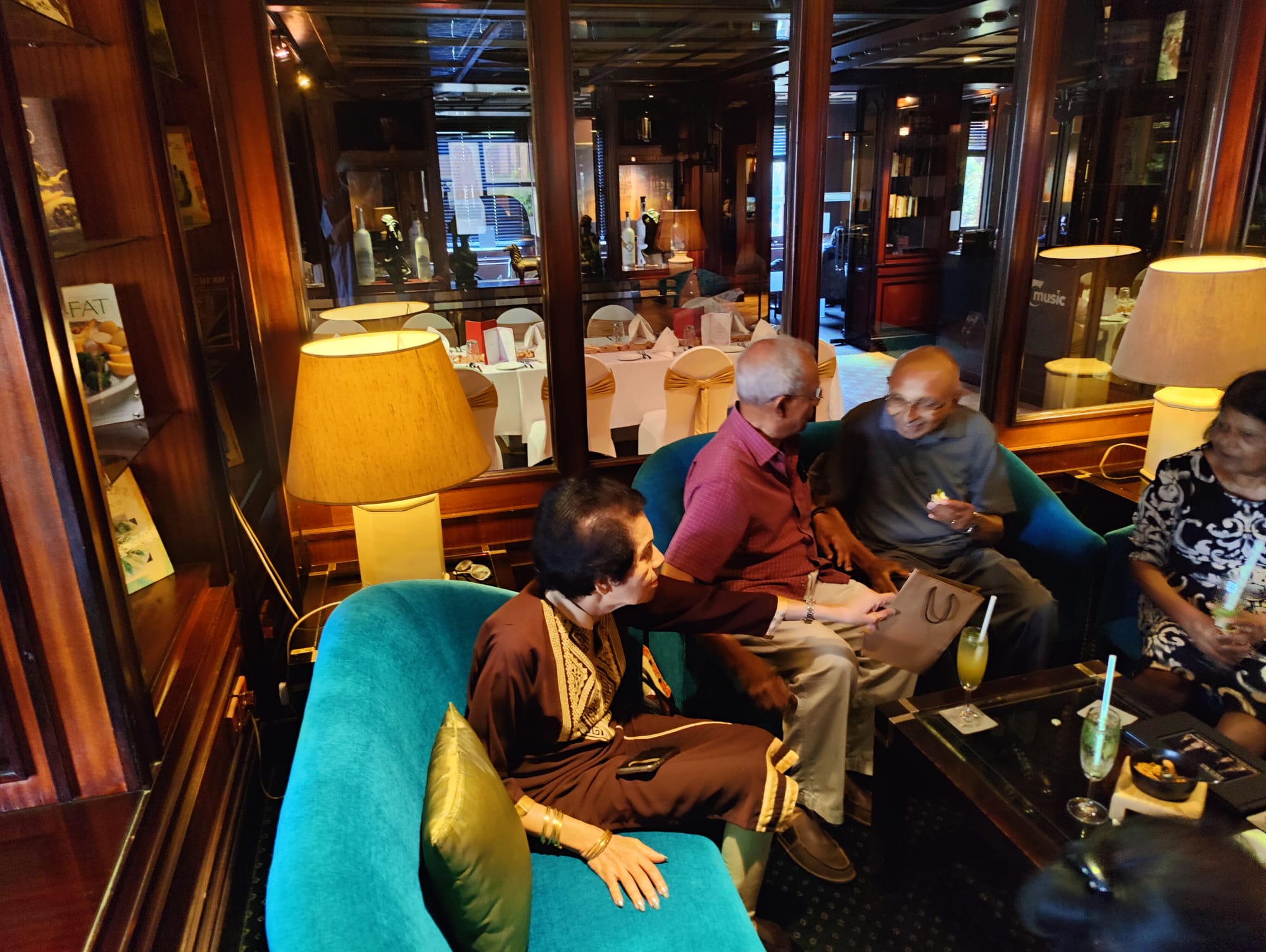
The indefatigable Pram organised a Foerver 62 group lunch to greet visiting batchmates "Speedy" Mahendra Gonsalkorale and Srianee "Bunter" Dias.

Many batchmates living in Sri Lanka attended this most enjoyable occasion. Sanath Lamabadusuriya, Vasanthy Thuraisingham, Harsha Samarajeewa, Lucky and Mangala Abeygunawardena and Manel Wijesundera were unable to attend and sent their apologies. It was great to see many spouses, too.

The sumptuous meal was enjoyed by all, and as is customary on these occasions, many events from our batch days were recalled with affection. Many who were meeting after a long time were met with the usual "you haven't changed a bit" remark, which is always amusing as well as flattering.


Wednesday, February 21, 2024

MY PAINTINGS OF FRUITS 1 - Chirasri Jayaweera Bandara

MY PAINTINGS OF FRUITS  1

WITH THEIR HEALTH BENEFITS

Dr. C. D. Jayaweera Bandara

I have given the scientific name of each. Some of the claimed Health Benefits as described may not be strictly scientifically verified and are debatable. Some claims are highly generalised and open to question. Readers can make up their own minds, and I shall be keen for your feedback.


AVOCADO        Persea Americana       RAMBUTAN   Nephelium lappaceum

POMEGRANATE Punica granatum       PINEAPPLE  Ananas comosus


MANGOSTEEN Garcinia mangostane   PASSION FRUIT GENUS  Passiflora edulis

HEALTH BENEFITS OF FRUITS

ANTIOXIDANTS  ARE PRESENT IN ALL  6  ABOVE  FRUITS

ANTIOXIDANT FRUIT BENEFITS

Epidemiological prospective studies show that higher intakes of antioxidant-rich fruits are associated with a lower risk of chronic oxidative stress–related diseases like cardiovascular diseases, carcinoma and death from all causes.

Other benefits of Antioxidants

1.   Boosts immune system.

2.   Reduce inflammation

3    Support disease prevention

4.   Support Eye Health

5.   Aid in brain function

6.  Contribute Mental health improvements

7. Support healthy ageing processes

1 AVOCADO

In addition to the above benefits of Antioxidants, Avocado

8.  Keeps heart healthy, rich in monosaturated fat that helps in reducing bad cholesterol

9.   Lowers BP, loaded with Potassium, which makes it good for people with high BP

10. One of high protein which helps in the building of bones, muscle, cartilage, skin and blood

11. Packed with fibre, which helps in weight loss and reducing Blood sugar

12. Improves digestion. High in B vitamins. B Complex vitamins very important for cellular metabolism and digestion

2  RAMBUTAN

In addition to the above benefits of Antioxidants, Rambutan

8.  Lowers LDL Cholesterol

9.  Improves digestion

10. Excellent for weight loss

11. Strengthens teeth and bones

12. Cleans the Kidney

13.  Tones skin

14.  Regulate blood sugar

3  POMEGRANATE

In addition to the above benefits of Antioxidants, Pomegranate

8. Provides Potassium crucial to the heart, muscles, nerves, etc.

9. Vitamin C protects cells, heal wounds

10. Folate and Thiamine help with growth, development and cell function

11. Manganese helps to form bone and joint tissue.

12. Has Urinary and Prostate healthy benefits

4  PINEAPPLE

In addition to the above benefits of Antioxidants, Pineapple

8.   May reduce your risk of Cancer

 9. Strengthen bone

10. Good for teeth

11.  Maintain skin health

12.  Strengthen nails and prevent hair loss

13.  Aids in digestion

14.   Reduce symptoms of arthritis

15.   Prevents hypertension

16.   Has astringent properties which strengthen gums and make sure your

teeth do not get loose

5  MANGOSTEEN

In addition to the above benefits of Antioxidants

8. It has become known as the Queen of Fruits and Fruits of God

9. Mangosteen is used for Diarrhoea, UTI, Gonorrhea, Thrush, TB, Menstrual disorders, Cancer, Osteoarthritis and Dysentery

6  PASSION FRUIT

In addition to the above benefits of Antioxidants

8.  Reducing Cholesterol and boosting heart health.  Loaded with heart-healthy Potassium and low in Sodium, it helps reduce BP.

9.   Good source of fibre and is gut-friendly, preventing constipation and bowel disorders

10.   Low glycaemic index.  Good for Diabetics

11.   Improve Insulin Sensitivity

12.   Contain Magnesium decreases Stress and anxiety    

Sunday, February 18, 2024

Art and the Artist- Srianee Dias

Art and the Artist

By Srianee “Bunter” Dias (nee Fernando)

- "Should we not separate the creative work from the personal lives of the creators and appreciate the works for their artistic value”- 

While reading The New Yorker magazine online recently, I came across this article entitled “The Second Death of Pablo Neruda.”  It sparked my interest because Kumar G. and others had written about him previously on our Blog. Neruda was a Chilean poet who led a colourful life, and was a supporter of the socialist President Salvador Allende, who was overthrown by Augusto Pinochet in a coup in 1973. For generations, Neruda’s prestige in literature was unquestioned, but now it appears that his life, his work, and even his death are under scrutiny. 

He first published his poetry using the pen name “Pablo Neruda” when he was just 19 years old, and kept on writing poetry throughout his career in the foreign service.  One of his appointments was in Colombo.  Later he was elected to the Senate in Chile, and officially joined the Communist Party. He won the Stalin Peace Prize in 1953 and the Nobel Prize in Literature in 1971.  He was revered and celebrated in Chile long after his death in 1973.  His homes in Santiago, Valparaiso and Isla Negra are now museums visited by thousands of visitors. 

Things began to change in 2011 with a strong feminist movement demanding accountability for Chile’s institutional violence against women.  There were street demonstrations demanding non-sexist education in schools and protests against sexual harassment of women.  Details of Neruda’s life began to be viewed in a different light; his womanising and his treatment of his daughter, who was born with hydrocephalus.  There was also his own confession of the rape of a maid in Colombo when he was in his late twenties.  Neruda wrote about this incident in his book “Memoirs.” (The original Spanish title of this book translates as “I Confess That I Have Lived.”)   There is a movement in Chile now to recognize Gabriela Mistral as Chile’s foremost poet instead of Neruda. 

These days, when Neruda’s work is taught in universities, the students frequently challenge the professors.  Isabel Allende said it best: “Like many young feminists in Chile, I am disgusted by some aspects of Neruda’s life and personality.  However, we cannot dismiss his writing.” 

After reading this article, I began to think, is it fair to denigrate, blacklist, and banish the creations of talented artists/writers/poets/actors when serious personal misdeeds are revealed?  Should we not separate the creative work from the creators' personal lives and appreciate the works for their artistic value. In the distant past we were far more forgiving.  Of course, there were no social media then to generate frenzied emotional rhetoric. 

An artist whose paintings I have long admired is Michelangelo Merisi da Caravaggio known simply as Caravaggio.  He was a violent man who killed a man when he was a teenager and was forced to flee his village.  Throughout his life (1571-1610) he was involved in drunken brawls and possibly even more killings.  He subsequently died in Naples after being injured in a fight which led to wound infection. His paintings are magnificent, featuring struggles, torture, death, and biblical themes.  He was known for his dramatic use of light – chiaroscuro- (the treatment of light and shade in drawing and painting)  and tenebrism (painting using especially pronounced chiaroscuro, where there are violent contrasts of light and dark).  He was also known for painting directly from life on the canvas without first drawing the subject, which required exceptional talent.  Despite his violent and murderous ways, his paintings have not been condemned to the basement of museums.

Paul Gauguin ( 1848-1903), whose vibrant paintings have delighted many of us, left his middle-class life as a stockbroker, a life including a wife and five children, and moved to French Polynesia.  There he “married” several young women who were about 14 years old. Gauguin’s paintings continue to be exhibited proudly in many museums in spite of his questionable lifestyle. 

Pablo Picasso (1881-1973) was another genius who famously treated the women in his life miserably.  He created about 20,000 paintings, prints, drawings, sculptures and ceramics. His style evolved from realism to abstraction, cubism, surrealism and expressionism.  He is held in great esteem in spite of his many character flaws. 

One of the most shocking revelations in recent years was when the actor/comedian Bill Cosby was accused by several women of sexual assault.  My daughters and I had been fans of his many TV productions, which included some children’s shows where he played loveable, funny characters.  Most recently, he played the affable Dr Cliff Huxtable on The Cosby Show, a doctor and a dad handling the usual family crises with great humour.  Reruns of the show were being aired when Bill Cosby’s trial began, and many TV networks decided to stop airing the reruns.  They punished not just him but all his young co-stars as well.  Bill Cosby got his judgment in court, and I thought the actions of the networks were quite unnecessary and not justified. 

A work of art, literature, poetry, stage play, film, or television series should be appreciated and judged on its own merits.  It is distressing when we discover that the people involved in creating such works have major flaws ranging from racist views to sexual abuse and even murder.  As difficult as it may be, I try to separate the creation from the creator whenever possible and appreciate the work on its own merit.

My guess is that not everyone will agree with this viewpoint.

(graphics inserted to original post  by Mahendra)

Thursday, February 15, 2024

Sriani Basnayake Dissanayake passes away

Sriani Basnayake Dissanayake passes away. Feb 15, 2024

Pram and Nihal have just conveyed to me the sad news that Sriani Basnayake (nee Dissanayake) had passed away today.

16 Feb Message from Pram. Her remains lie at the A.F. Raymond Parlour on the 19th of February 2024 from 9.00 am, and the cremation will take place at 3.00 pm at the Anglican section, Borella Cemetry. A service at 2.30 at the parlour.

Sriani's husband Ralph Wickremaratne passed away last year. Sriani has not been too well for a few years. She was one of the few who migrated from the Peradeniya batch to Colombo.

This photo was taken at the 2012 Reunion Scientific Meeting. On that day, she kept us educated, informed and entertained with her presentation titled,  "What Prevents the Urge to Merge?" - The Problem of Non-Consummation. 

Her sense of humour was well recognised and she often contributed a lot of funny snippets to the Blog in its early days.

She is also well known for her work with the FPA (Family Planning Association) for over 30 years. She was a devout Christian. She is the 54th loss from our Batch

Sriani posted really funny articles on the Blog. I am sure she would have approved of me posting one of her jokes to illustrate her good nature and ability to see the funny side of things. Let us remember her for her professional contributions as well as her great sense of humour.

This is her story about the Baptist Bra.

A man walked into the women's department of Macy's in New York City. He told the saleslady, "I would like a Baptist bra for my wife, size 36B.".


With a quizzical look, the saleslady asked, "What kind of bra?"


He repeated, "A Baptist bra. She said to tell you that she wanted a Baptist bra and that you would know what she wanted."


"Ah, now I remember." said the saleslady, "We don't get as many requests for them as we used to. Most of our customers lately want the Catholic bra or the Salvation Army bra, or the Presbyterian type."


Confused and a little flustered, the man asked, "So what are the differences?"


The lady responded, "Well, it's really quite simple. The Catholic type supports the masses, the Salvation Army lifts up the fallen, and the Presbyterian type keeps them staunch and upright."


He mused at that for a moment and then asked, "So, what is the Baptist type for?"

"They," she replied, "make mountains out of molehills."


Sriani, we shall all miss you. - Mahendra Gonsalkorale.


Sriyani Basnayake -an appreciation Added on 17-02-2024

Dr Kumar Gunewardane

 “Like a bird singing in the rain,

Grateful memories will survive in times of sorrow" 

Tusitala: R.L.STEVENSON

The news of Sriayani’s passing away, though not totally unexpected, caused my wife Kanthi and me much grief.  She was a good friend to both of us, and we cherish many affectionate memories of her.

A welcome Peradeniya migrant to our ‘62 medical student group, she, in ND’s apt words, turned many heads. She had, in abundance, the fabled panache of Ladies College alumni. Pram’s photographic portrait does justice to her allure. Although somewhat reserved, she never displayed her elite background. Her father was the Inspector General of Police when that position was one of distinction and uprightness. 

I hardly knew her in Medical School, but this was a common failing of most of us who kept to our isolated groups. The reunions and the blog helped break these barricades.

Sriani B is, fifth from Right seated
The year of internship at the Mahamodera Hospital in Galle further eroded these barriers. It was indeed an “annee glorieuse”. While observing with amusement the riotous activities of the hoi polloi Sriani always maintained a dignity inherent to her. This was indeed an attribute of all our female colleagues. 

Our next encounter was in Townsville, North Queensland. Her sister Nirmala, another distinguished product of Ladies College, was married to Justin Labrooy, our local university's Foundation professor of medicine. We spent many joyous hours in their company. Both sisters had the endearing and rare quality of simplicity. N was a champion national athlete and also the holder of a doctorate from the University of Oxford. Sriyani was the chief of the family planning service in Colombo. Both were remarkably reticent of their achievements. 

Our standout memory of that time is S’s Reiki therapy for Kanthi’s migraine headaches. Reiki is an ancient Japanese technique of relaxing massages, and Kanthi derived significant benefits from her ministrations in the solitude of a quiet room. 

She was also a gracious host to us in her ancestral home in Borella. There, she introduced us to her nephew, to whom she was a foster mother. His father, the gifted surgeon Lakdasa (S’s brother) had passed away while attempting to rescue two drowning children. 

Sriyani’s brilliant lecture “What prevents the urge to merge” at one of our reunions has already been alluded to by others. Her wit and humour were amplified by many well-chosen slides, which made me inquire which medical journals she had resourced; she deftly sidestepped that one. Of course, they were from her leisure reading. On that occasion, she was accompanied by her husband Ralph Wickremaratne, a perfect gentle knight and sportsman. They were a flawless match.

We have lost a good friend and a gifted colleague. May God be with you. 

“Every blade in the field,

Every leaf in the forest,
Lays down its life in its season,
As beautifully as it was taken up.”

Henry David Thoreau 

“We will grieve not, rather find strength in what remains.”

William Wordsworth


An appreciation by Nihal D Amarasekera (Photo sent by Pram)- 16/02/2024

I recall the time Sriani joined us from Peradeniya in our third year. She made heads turn by her immaculate dress sense and elegance. Sriani carried herself with such poise and dignity which gave an insight into her gilded life at home. Although rather reserved and steely at times, she was friendly and jolly. Sriani had a fund of funny stories and was delightful company.

She was a regular in the early days of the batch blog, and I remember with clarity some funny stories and interesting comments she posted. When I wrote about a maid who cared for me as a child, she wrote about her experiences too.

Sadly I never met her after the great dispersal of 1967. I never joined in any of the reunions in Sri Lanka. But I always received news about Sriani from her friend from Ladies College, Suvendrini Weerasekera. It was deeply upsetting to hear of her difficulties with her final illness, which she bore with great courage.

Sriani was a caring professional and served the people with great empathy and understanding.
May her Soul Rest in Peace.

Monday, February 12, 2024

Brief Encounter-Nihal D Amerasekera

Brief Encounter – A movie masterpiece

By Dr Nihal D Amerasekera

Sir Noel Coward (1899-1973) was a flamboyant Englishman. He was a playwright, actor, singer and much more. Noel Coward was Knighted for his work.  He became famous for his song "Only mad dogs and Englishmen go out in the midday sun". Coward wrote the one act play “Still life” in 1936. This was a turbulent time in the world. King George V had died, and Edward VIII was made king only to abdicate. Germany was preparing for war. WWII shook the world. It ended in 1945 with the loss of 85 million lives and causing immense hardship to many.

The British film director David Lean (1908-1991) made the story of “Still Life” into a romantic drama, calling it the “Brief Encounter”. The film was shot in the final days of WWII. It was premiered in London in 1945. He is no stranger to epic films. Many of his movies had become box office hits like “Dr Zhivago”, “Lawrence of Arabia”, “Bridge on the River Kwai” and “A Passage to India”. David Lean is greatly respected for his mastery of film craft for which he was given an all-time achievement award in 1990. Brief Encounter is often referred to as the best movie romance of all time. It received three nominations at the Academy Awards, Best Director, Best Actress (Celia Johnson), and Best Adapted Screenplay. In 1999, the British Film Institute ranked it as the second-greatest British film of all time.

David Lean chose the leads: Celia Johnson as Laura - a housewife, Trevor Howard as Alec - a doctor. Stanley Holloway plays the naughty station master and Joyce Carey as the bossy, buffet manageress. Marital infidelity with the associated social and emotional upheaval is the subject of the film. Laura and Trevor both married to their partners and with children meet at Milford train station, just by chance. Laura got some grit in her eye and asked for some water at the station buffet when a kindly Dr Alec Harvey, came to help. That’s how it all began. Their affection for each other grew as they met at the station café again and again on several occasions. Meetings were always on a Thursday, she was on her shopping trips and he was there for his work commitments. Once they went to an afternoon performance at the Palladium Cinema.  During these recurrent weekly visits their casual friendship developed into something more emotionally fulfilling than either of them expected. After their breakup, David Lean allows Laura to deliver the anguished narrative, in flashback, when the doctor takes his family to a new life in South Africa. Her desire and longing for Alec only gets more intense. The heartache and despair felt by Laura is brilliantly portrayed. As Laura relates the story her face projects the feelings and emotions perfectly. The chemistry between Laura and Alec is exquisite. Their flawless sense of decorum and style all through film is a tribute to that British dignity and decency of the 1930’s.

The first colour film was made in 1908. It wasn’t until the late 1940’s when colour films became more common. Like most films of the early 1940’s “Brief encounter” was made in B&W. The superb cinematography in the railway station with the focus on low lighting and the loud announcements from the public-address system creates the ideal ambience for the story. B&W makes the images menacingly atmospheric. This also suited the story perfectly depicting a certain poignance, a place faraway and of a time long ago.

The film is etched in nostalgia to an era when public transport was the norm and cars were expensive and few. Steam trains were popular and ran on time. The noise, dust and the puffs of smoke make us remember that era of steam with much affection. The hustle and bustle of a busy train station adds to the urgency of their brief meetings. The camera eavesdrops on their random mundane conversations. The announcements on the public address system of train arrivals and departures conveys the beginnings and the endings of their trysts abruptly adding to the agony and the ecstasy. The emotional rollercoaster of the illicit affair is beautifully portrayed.

There are certain songs and melodies that are inextricably linked to films. They seem to linger in our sub conscious minds forever. Anytime we hear the music our thoughts are directed to parts of the movie. This is so with Lara’s theme in Dr Zhivago, “As time goes by” in Casablanca and eminently true for Brief encounter. The theme music that is played right through the film is Rachmaninov’s piano concerto No.2. This is recognised as an epic work of genius. Rachmaninov (1873- 1943) was a Russian composer and pianist. He composed the score in 1900 when he had recovered from clinical depression. He dedicated his work to his psychotherapist. The second movement creates a cloud of sentimentality ideally suited, in particular, for the important final scene in Brief encounter. After the Revolution he left Russia and settled in New York.

Human history is littered with stories of adultery since the beginning of time. “Thou shalt not commit adultery” remains one of the Biblical Ten Commandments for Christians. Religions, Society and even the current legal systems take a dim view of adultery. There are strong cultural norms too that discourage such behaviour. This film made in those censorious times, family and stability are respected and preserved. The moral of the story has remained consistent since the film was first shown in 1945. However, with the passage of years people are more understanding of how such a situation could occur. Unplanned, inopportune, and inelegant, this is how romance happens in the real world. Marriage vows are sacred, and the union is sacrosanct. We salute Laura and Alec. They both earn our sympathy and respect for their wisdom.

It is important there is a release for marriages that are beyond reconciliation for a multitude of reasons. A further discussion on this subject goes beyond the scope of my remit.

Although there is a loathing for adultery and extramarital affairs, people love to know and hear about it. The media are quick to publish salacious details. With the modern way of life, men and women mix freely at work, home, and social functions. The social media and emails on mobile phones allow secrecy and easier contact. This enhances the opportunities for clandestine relationships providing the climate for gossip and innuendo. Hollywood, Bollywood and film makers around the world make use of this human weakness to create gripping stories that become money spinners for them. It is now hard to find a movie without such steamy and sensuous details.

This film is a timeless classic. Brief Encounter grabs you from start to finish. It’s a great story beautifully told. The movie is a masterclass in cinematography. I have made a conscious effort not to outline the entire story just in case I have enticed a reader to see the film. It is a gentle reminder of what it is like to be in love!! One may even search the past for similar events in one’s own life. I have watched Brief encounter many times and have been genuinely moved each time. It still is one of the most cherished movie experiences I’ve had.