Tuesday, February 16, 2016

Important Message

Dear Friends,

This important message is being sent out to all members of our batch whose e-mail addresses are on record with me. It is about the 50th anniversary celebrations since our graduation in 1967. We hope to hold this event in Sri Lanka in 2017.

You will recall that we had a highly successful Reunion at Chaya Blu in 2012 to celebrate the 50th Anniversary of our entry to the Colombo Medical Faculty in June 1962. Let us try and do even better in 2017 with more participation. 

To do that, we need to prepare the ground work before deciding on dates and venues. First of all, I have to update my e-mail list which still remains the most convenient way of contacting you all.

Let me also remind you that I am doing all this voluntarily on your behalf. I agreed to function again as the Secretary of the Organising Committee at Swyrie's request, only on condition that she will again lead the effort as she has been doing for many years.

As I have said repeatedly, there are many in the batch who have not provided e-mail addresses. Whenever I send out a general e-mail, I have also noticed that many of them bounce back either because the addresses have been changed or that some do not check their mail regularly. To begin with, let us address this issue. Other formalities like co-opting a few more members to the Organising Committee will be done at the first planning meeting to be held shortly. 

Below is a list of those who have never been in touch with me since we graduated in 1967. Some of them have e-mail addresses (on paper), but they never reply.

1. Anandappa, Marie 
2. De Silva, Bernadette
3. De Silva, Mahasena (KLMT)
4. Dolawatte, Piyaseeli                                  
5. Doss, A.E.J.  
6. Goonawardene, Kamini
7. Goonawardene, Padmini        
8. Hettiarachchi, Manel                   
9. Jayatilaka, Saradha                                                     
10. Kanagasabai, Sushila
11. Kanapathipillai, Easwaran
12. Navaratnarajah, Manohari
13. Navaratnasingham, G.J.
14. Perera, Chitra
15. Perera, Dharmini
16. Perera, Gwendoline
17. Perera, M.G.F.
18. Ramanaden, Shirlene
19. Ramanathan, U.C.
20. Rasanathan, M
21. Ratnavel, Sue
22. Samarakoon, Edwis
23. Saparamadu, P.D.D.
24. Sathanathan, S                       
25. Shanmugavadivel, Vanitha
26. Selliah, S.
27. Selvadurai, S
28. Silva, Rita
29. Singharayer, M.
30. Sivananda, P.
31. Subramaniam, Indrani
32. Thiraviam, P.
33. Thirunavukarasu, Tilaka
34. Visvanathan, M.
35. Wickramasinghe, L.P.J.M.
36. Wijeyekoon, Asoka

The following have e-mail addresses, but my e-mails always bounce back. Or they never reply.
                                                                      
1. Abhayaratne, Rohini 
2. Balasubramaniam, N.
3. Chinniah, Navam
4. De Silva, Ananda  (UVA)                                                        
5. Wickramasekaran, R. 

I need your help in contacting the above named in both categories. If you are in touch with any of them, please forward this e-mail to them if they are on e-mail. Otherwise, just keep them informed by some other means and try to rope them in.

Before I conclude, I must state that two members who were in the Organising Committee in 2012 have passed away since then. They are Priya Gunaratne and Lucien Perera. We will not have such a large committee this time but rest assured that I will keep you informed with regular updates.

For your information, I give below the list of members who have left us for ever. May they Rest in Peace.

   Members of the 1967 Batch who have passed away
  1. S.R. (Sunil) de Silva
  2.  A.R.K. (Russel) Paul
  3.  Dawne de Silva Paul
  4.  Bernard Randeniya
  5. Niriella Chandrasiri
  6. V. Ganeson
  7. L.G.D.K. (Irwin) Herath
  8.  V.Kunasingham
  9.  B.L. Perera
  10. B. Somasunderam
  11. K.Sunderampillai
  12. Tudor Wickramarachchi
  13. K.N. (Kiththa) Wimalaratne
  14. Anna Ponnambalam Sathiagnanan
  15. A. Satchitananda
  16. N. Sivakumar
  17. Tilak.A. Dayaratne
  18. Sidath Jayanetti
  19. N. Balakumar
  20. Kamali Nimalasuriya de Silva
  21. K. Sri Kantha – 15.9.13
  22.  P. Lucien Perera – 14.6.14
  23. Priya (Gunaratna) de Silva – 8.10.14
  24. Arul (Sivaguru) Balasubramaniam – 15.10.14
  25. W. Punsiri Fernando – 15.11.14
  26. W. Rajasooriyar – 6.1.15
  27. M.P.C. Jaimon – 26.3.15
  28. S. Vedavanam – 1.7.15

Await further news.  

      Cheers!
    
      Lucky
                  

Sunday, February 14, 2016

Interesting Programme on BBC

Seeing with sound using clicking with the tongue against the roof of the Mouth.
                                     
Recently on BBC Radio 4, a programme was run in which a boy of 10 years, born completely blind was taught the art of ‘seeing like a bat’ by the very Batman from USA, Daniel Kish who uses the sound from clicking his tongue against the roof of the mouth while holding the mouth pursed, and receiving back the echo from his surroundings and training himself to detect substance, texture and distance of items in his surroundings. Using this method he can safely navigate his way through roads and crossing roads avoiding traffic.  Ethan using the same method can go to school without any mishap. The idea of doing this started with Ethan’s great talent in music. He had an extraordinary talent of listening to everyday sounds like that of a washing machine, birdsong, and vacuum cleaner and converting it to piano music sounds which would take complicated but beautiful forms.  His mother succeeded in getting him entered into St Mary’s School, Edinburgh, one of the most prestigious schools in the UK. He was St Mary’s first blind pupil and his difficultly in getting around prompted his parents to contact Batman, who they had met on holiday in the US. Batman, Daniel uses the method that bats use to see. He would cycle down the street ‘clicking’. He could differentiate between objects, surfaces, and motion of and distance of objects, the process being called echolocation.A team of neuro scientists studied the phenomenon and to their surprise they found that Daniel was accessing the visual cortex. Professor Gordon Dutton says by ‘watching’ his surroundings by the echo that returns form his clicks he was recreating a visual picture, which stimulated the visual cortex as it happens in a sighted person. This is called Echology.

Ethan after his training by Batman, managed to attend school and as a gifted musician now with his Batman vision, was able to play in an orchestra at a concert at his school. Ethan and his family along with Daniel climbed a hill the two blind individuals using just their white sticks and echoes from clicking with the mouth.

References:

Seeing like a bat with Daniel Kish
http://bbc.in/1PrVpAa

Ethan playing the piano
http://bbc.in/1Te4QWe

Link to the programme

Sent by

Zita Perera Subasinghe

Saturday, February 13, 2016

Their names liveth forevermore

By Dr. Nihal D Amerasekera

There are many from my era in medical school who feel deeply grateful for the fine education they have received. Gratitude is one of the finest of human qualities. It is a divine gift respected in the Eastern cultures.  Appreciation of ones’ teachers is a tradition as old as teaching itself. I must reiterate we were students in the golden age of medical education in Colombo with a plethora of some of the finest lecturers and clinicians we have ever seen in our island. While I can’t pretend to have matched the dizzying heights of their success, those long five years of interactions with our teachers made a significant lifelong impact on many of us. They were inspirational. It is my greatest pleasure and privilege to remember a few of them on this Blog.

Dr Don Jinadasa Attygalle
He was born in 1916 in the southern city of Galle. After his education at Royal College Colombo he entered the Colombo Medical College. He qualified LMS in 1941. DJA married Dr. Daphne Kanakaratne in 1951. She later became the Professor of Pathology. He worked in the Health Service in various parts of the country and sailed to England in 1951 where he remained until 1954. There he obtained the MRCP and returned to Ceylon to complete the MD examination.

He was tall, well groomed, impeccably dressed and ever courteous. From what I recall he was a dignified man of few words. Whenever he spoke to the patients, doctors or students he was calm and spoke respectfully. DJA was of a quiet and reserved disposition, never flustered, never upset. He had the ability to show and teach genuine compassion.

He took great care to teach us well. He corrected our mistakes but never lost his cool. DJA was a fine teacher of the best traditions of our era and taught us the basics well. He was a quiet retiring person who never looked for publicity. A few could claim to know him well.

DJA had a fine private practice where he saw patients at home and also at the many private hospitals. He never came across as a money grabbing doctor. He retired in 1972 but continued to see patients privately.
Mrs Attygalle passed away in 1989 and Dr DJ Attygalle in 1997. They had no children.

He was a devout Buddhist all his life and donated his house at 50, Castle Street to the YMBA.

I feel immensely proud to have been taught by such a great man whom I admire enormously. Despite all his achievements, those of us who were privileged to train under his guidance remember him mostly for his humanity.

Dr Ernest Victor Pieris
He was born in Badulla in 1926. His father was a doctor. After his education at Royal College Colombo he entered the Ceylon Medical College. There he qualified as a doctor with 1st Class Honours and distinctions in Medicine, Obstetrics and Gynaecology. He proceeded to the UK and obtained  his MRCP degree. On his return he obtained his MD.  EVP was appointed Consultant Physician to the GHC in 1960.
EVP was a dedicated and meticulous physician. He was a kind, skillful and compassionate doctor and took great care of his patients. EVP was a popular physician in the private sector but he never neglected his duties  to his poorer patients at the GHC and his numerous teaching commitments.

Although soft spoken he was no pushover.  He had a tremendous sense of humour. He was well known for his acerbic and often amusing comments while on his teaching rounds and ward classes.

I did a 2 month appointment with him when I learnt much of my medicine. He had the skills to teach and also to make the students learn. EVP never suffered fools gladly. At his ward classes and appointments he saw to it that medical students learnt the bedside manners and the clinical methods. When he felt someone didn’t work hard enough he made sure they moved to the front and took an active part. I learnt much from him and feel immensely grateful. He gave some brilliant tutorials when we were in the final year. EVP maintained a healthy distance between himself and the students and made certain everyone knew his/her place all through his years of teaching. He was hard to please but appreciated good work.

He retired in 1972 and continued to see patients privately.
EVP was a good sportsman and he played Cricket and Rugby for Royal College. He captained the University Rugby Team.

He was married to a chest physician and had four daughters. EVP was a staunch Christian. Dr EV Pieris passed away in December 1991.

Dr. M. Oliver Robert Medonza
He was born in 1913 and had his education at St Benedict’s College Kotahena. He entered the Ceylon Medical College in 1934.  Dr Medonza completed his medical degree with First Class honours and distinctions in Medicine, Surgery, Obstetrics and Gynaecology. In 1952 he obtained his MRCP and also the MD. Soon after he was appointed Consultant Physician to the GHC. In 1972 he was appointed President of the Sri Lanka Medical Association. Dr Medonza retired in 1973.

He had a strong personality. I did a 2 month appointment with him as a medical student. My abiding memory of him is his wonderful bedside manner and his innate ability to speak to the patients in colloquial Sinhala and get to the bottom of the problem. MOR was a fine teacher and instilled in us the fine art of history taking and examination. He taught us to observe the patient and to elicit physical signs and interpret them accurately. He made it all look simple just like commonsense. He was always available to teach and to encourage, and never seemed harried or abrupt. It wasn’t often he was irritated by the students’ sheer ignorance but then it was all over very soon and he was back to his normal placid self. At the end of the 2 months he gave us a fine dinner at his house with plenty of  good food and drinks. On that eventful evening he was one of us and enjoyed like the rest of us.

MOR was a popular doctor and was a household name being in great demand in the private sector. He never neglected his duties to his patients at the GHC and his commitment to teaching.

In his student days he was a fine cricketer and a tennis player. Later on in life he played billiards and contract bridge in the company of a wide circle of friends which he clearly enjoyed.

He became a devout Buddhist and learnt Pali to translate the Dhammapada.
Dr Medonza passed away in June 1991.

Dr P.R.Anthonis


When I think of the surgeons that taught me the name that comes across in flashing neon lights, above everyone else, is Dr. PR Anthonis. He was not only a fine surgeon, excellent tutor, a fine raconteur, he was a phenomenon. PRA was a mentor to many. His ward classes were pure theatre and he knew the art of getting a message across to the students.  Although calm and placid he never tolerated nonsense.  He was firm when it was necessary. PRA was always courteous to his patients, his students and the nursing staff.  His natural curiosity led him to make fine observations. He tried his best to pass on this superb skill to his students.


The myriad of anecdotes which he related in his own inimitable style, still ring in my ears. He often had good, sound and practical advice about everything with a short personal story to go with it. Although he enjoyed a lucrative private practice even the poor patients worshipped him for his kind and generous ways. He elicited tremendous admiration and affection in the people he met.

He was born in 1911. After a brilliant school career at St Peter’s College Bambalapitiya he entered the Medical College in 1930. There he won the Gold Medal in Surgery amongst many other awards and scholarships. He passed the FRCS examination in 1945. On his return to Ceylon in 1947 was appointed Consultant Surgeon to the GHC where he rose far and fast.

After an illustrious career in the Health Service Dr Anthonis retired in 1971. He worked in the private sector well into his 80’s.


He was a devout Buddhist and passed away at the age of 99. His kindness, generosity and good humour are fond memories for us all. Many will remember him for being such an eloquent speaker and fluent writer. He was such a presence during our years his voice must swirl in the ether in the wards and corridors of the General Hospital Colombo.

Tuesday, February 9, 2016

My impression of School Cricket in the 1950’s - a spectator’s view

By Dr. Nihal D. Amerasekera

In those days without television, mobile phones and video games, cricket provided the entertainment and pumped up the adrenaline. We played softball cricket before school started, during the intervals, after school and at weekends. When there were no proper wickets- tree trunks, suitcases or black lines scribbled on a wall became perfect substitutes. Any space became our "oval". Occasionally, we got reckless with a sudden rush of blood, hit a six and broke the neighbour’s window. When we were not playing cricket, we talked and dreamed about it. Such was the strength of feeling for the game.

I joined Wesley College in 1950. At school, everyone played cricket. Watching the school matches at Campbell Park was a ritual never to be missed. Although 60 years have passed, I have vivid memories of some of those matches and the stresses and strains that accompanied them. 

Campbell Park is named after Sir GWR Campbell who was responsible for starting a "modern" Police Force in Ceylon in 1844. He retired in 1891 to become the Governor of Penang. This was later the grounds of the Tamil Union Sports Club until 1943 when it was acquired  for Wesley College.
Campbell Park is divided into 4 quadrants by 2 gravel cycle paths. Wesley lay claim to the northern quadrant. The southern quadrant became the grounds of the popular Bloomfield Cricket Club. Campbell Park was our amphitheatre. The Wesleyites, old boys and well-wishers line up on the Campbell Place side and the visitors were on the opposite side. We then had the old pavilion with the metal railings. The entire pavilion had the unmistakable smell of linseed oil. That was Wilbert the groundsman’s domain and us little boys were promptly and ruthlessly escorted out of the building.
We had a matting wicket then and a small score board maintained by enthusiastic students. The tall Andara hedge that separated Campbell Place from the park had a well heeled passage to creep through. On a visit to the Park in 2000, I saw the changes to the scenery since my time. I will always remember it as it was when I was at school.

To watch the games, we assembled in large numbers under the massive “Mara” trees that surrounded the grounds. Singing and chanting waving the school flag was part of the fun. The school song broke out spontaneously. We gathered in our hundreds and it had a carnival atmosphere. Often we sang:

Hurrah for the merry,
Hurrah for the land,
Hurrah for the Wesley Boys,
Who do not care a damn,
Everywhere the merry goes,
The land is sure to go.
Down with the battle cry of freedom

Little did I know the real meaning of this poem of Freedom by James Joyce when I sang it then. When the going was good, drums beat the more rhythmic tunes like the bailas. Often, as the afternoon wore on, the concentration was intense and the stress levels increased . To take a break, we sometimes walked back to school on Karlshrue Gardens for some refreshments. I can still remember the tall, dark, slim figure of Mr. Eric Gunasekera (a former Headmaster) then in the evening of his life and partially blind, waiting at his gate for news of the matches. We always stopped to greet and relay the events at Campbell Park. Alerics and Piccadilly Ice cream vans, with their engines humming, did roaring business on match days, as well as the achcharu ladies and gram sellers (a paper cone of roasted peanuts cost 5 cents).

To be a first eleven cricketer at Wesley was a great honour. They were placed on a pedestal and were much respected by all. Despite their teenage years, they received this adulation with poise and dignity. Much can be said about the discipline and training at Wesley which helped to produce such men of modesty and valour.

Cricket in those days was played by gentleman. Umpire’s word was law. School cricket was played in the best spirit of the game. We congratulated the opponents' achievements in the field. We walked away when we felt it was out, although the umpires did not see . The spectators dissent and applause was confined to areas beyond the boundary. No streakers, foul language or efforts to intimidate the batsman at the crease. When we lost, although crest fallen and frustrated, clapped the opponents back to the pavilion. Those injured in the heat of the battle were comforted by the captain of the opposite side. My generation grew up with peace. This gentlemanly behaviour on the pitch merely reflected the peaceful and chivalrous times of our youth.

St. Thomas’ was established in 1862 and had the most impressive buildings with large tall grey Greco-Roman columns. They had beautifully laid out gardens. I couldn’t say the same of their breezy turf wicket by the sea which was a cemetery for visiting teams. They have always had good strong teams. The school has produced many outstanding cricketers. The names that come easily to mind are Bertie Wijesinha, Michael Tissera, P. I. Peiris, Neil Chanmugam, Dan Piachaud, Buddy Reid and Lareef Idroos who shone in the 50’s. Their names are carved in my memory. Lareef and Buddy were at Medical School with me and helped University win the coveted Sara Trophy in 1962.

Royal College came into being in January 1835 as a private school christened "The Colombo Academy" and was situated at Hill Street, Wolfendhal. They moved to the present site next door to the University in 1923. It was a shorter journey to the Reid Avenue turf which was the Royal College grounds. On many occasions, I had preferred to watch from beyond Reid Avenue fence which gave a panoramic view of the red brick school, the pavilion and the action in the middle. They were always formidable opponents and had fine cricketers. Brendon Gooneratne, Ubhaya De Silva, EL and EB Pereira, Sarath Samarasinghe, Michael Dias, Darrell Lieversz and Nirmalingam are some of the names I recall with ease. Our very own Harsha Samarajiwa was a fine quickie who later played for the University to win the Sara Trophy. Royalists always fought their games hard and fair.

St. Peter’s grounds at Bambalapitiya was again a turf pitch. They had an elegant pavilion built on a hill overlooking the turf. The "Bambalawatte boys" gathered in their hundreds with their Brylcreemed Elvis Presley hair, speaking their own brand of pidgin English. The Wellawatte canal wasn’t far away and the smell of stagnant water was ever present. We could see in the distance, the tall chimney of the Wellawatte Spinning and Weaving Mills bellowing thick black smoke. Clive Inman, a product of St. Peter’s College, Bambalapitiya, is rated as one of the best left handed batsmen produced by the country. Clive came into prominence when he scored an unbeaten 204 against St. Joseph’s - which is still a record for schools big matches. Anton Perera was their lively fast bowler and HIK Fernando a fine wicket keeper for the school and country.

St. Joseph’s College was started in 1896. Their matting at Darley Road has been the site of many battles between our two schools. I recall the swimming pool end and the pavilion end. The school had impressive large buildings built around the grounds. The high dome of their chapel is breathtakingly beautiful. Travis and Carlyle Perera played for the school and later for the University. Whenever we won at Darley Road, we had to evade the hostile Maradana crowd for whom it was more than a game of cricket.

Ananda have always been formidable opponents. This match was resumed in 1956 and was played at the Nalanda grounds just next door to us. This made the contest rather fierce both for the cricketers and spectators. It was the personal pride at stake and we didn’t want to lose to our neighbours. Our hostelers just crossed the small park and jumped the fence running down the steep hill to the Nalanda grounds. Yatagama Amaradasa, Mohanlal Fernando, Kumar De Silva and the Polonowita brothers are the names I can recall. 

The match against Kingswood was played at Randles Hill, Trinity at Asgiriya and Richmond at the Galle Esplanade.

Wesley College too had some fine cricketers during my years at school. Ansar Fuard was an astute captain and was ably assisted by his brother Abu’s fine off spin bowling to complete a very successful year. Abu later went on to play for Ceylon and also became an influential member of the Selection Committee. Radley and Bryan Claessen were fine cricketers who captained school.  1955-56 were the Lou Adhihetty years. He was a great all rounder who brought honour to himself and the school. Lou’s name appeared in the national papers regularly for his fine performances with the bat and ball.

The cricket coverage in the daily papers were full of cliches. "Rain stops play", "Benedictines skitled for 65 runs", "Tame Draw at Darley Road". "Royal routed for 89 runs". Any Tournament was called a Tourney!! Even now it is wonderful to see the cricket analyses of Elmo Rodrigopulle who was such a fine player for St. Benedicts in the 50’s. It was wonderful to have Cyril Ernest in our batch who played for St Benedict’s and the University.

School Cricket in Sri Lanka is played in the dry season January to April being so dependent on good weather. I recall the many times watching the game in the blistering heat of the mid day sun with perspiration dripping from every pore. There have been times when the whole game has got washed off by a sudden burst of bad weather. This was indeed a great disappointment for us all. I remember the times when I have prayed for rain when our team was losing!! There is nothing more heart breaking than to see a winning team robbed of victory by a quirk of nature. To have the better team isn’t enough to win matches but good fortune must shine on them too.

The big matches, Royal-Thomian, Josephian-Peterite, Ananda-Nalanda and several others were great spectacles on and off the field. Cars, lorries and vans were commandeered for merry making and some of the excesses went beyond the acceptable. The cricket was of the highest standard and  many of the games being played at the Colombo Oval. As a schoolboy, I never missed the opportunity to watch the cricket and was never disappointed.

The enchantment of the cricket matches of my childhood still haunts me. At school, cricket was not only a game but a way of life. My lasting memory of cricket at Campbell Park is the sight of the setting sun behind All Saints Church and its lengthening shadows. As the bails were lifted, we all departed discussing the ups and downs of the day’s play. Losing a match in those days was like the end of the world, but we always bounced back. It was certainly a good training to face the peaks and troughs of our own lives. The songs we sang and the friends I made are etched deeply in my memory.
After leaving school in April 1962 - I went for some matches in the following year. The magic and the aura of this extraordinary spectacle seem to have vanished, not being an integral part of the school anymore. Thereafter, life got too complicated building my career. I never saw any matches at Wesley again. Ah! Those were the days.

I dedicate these notes to the many schoolboy cricketers from all the schools who entertained us in the 1950’s. They have done us proud. Our heartfelt thanks to the Groundsmen, Cricket Coaches and the Masters in Charge of cricket who made it all happen in the background, while we sang and beat the drums.


Sunday, February 7, 2016

When we met old friends

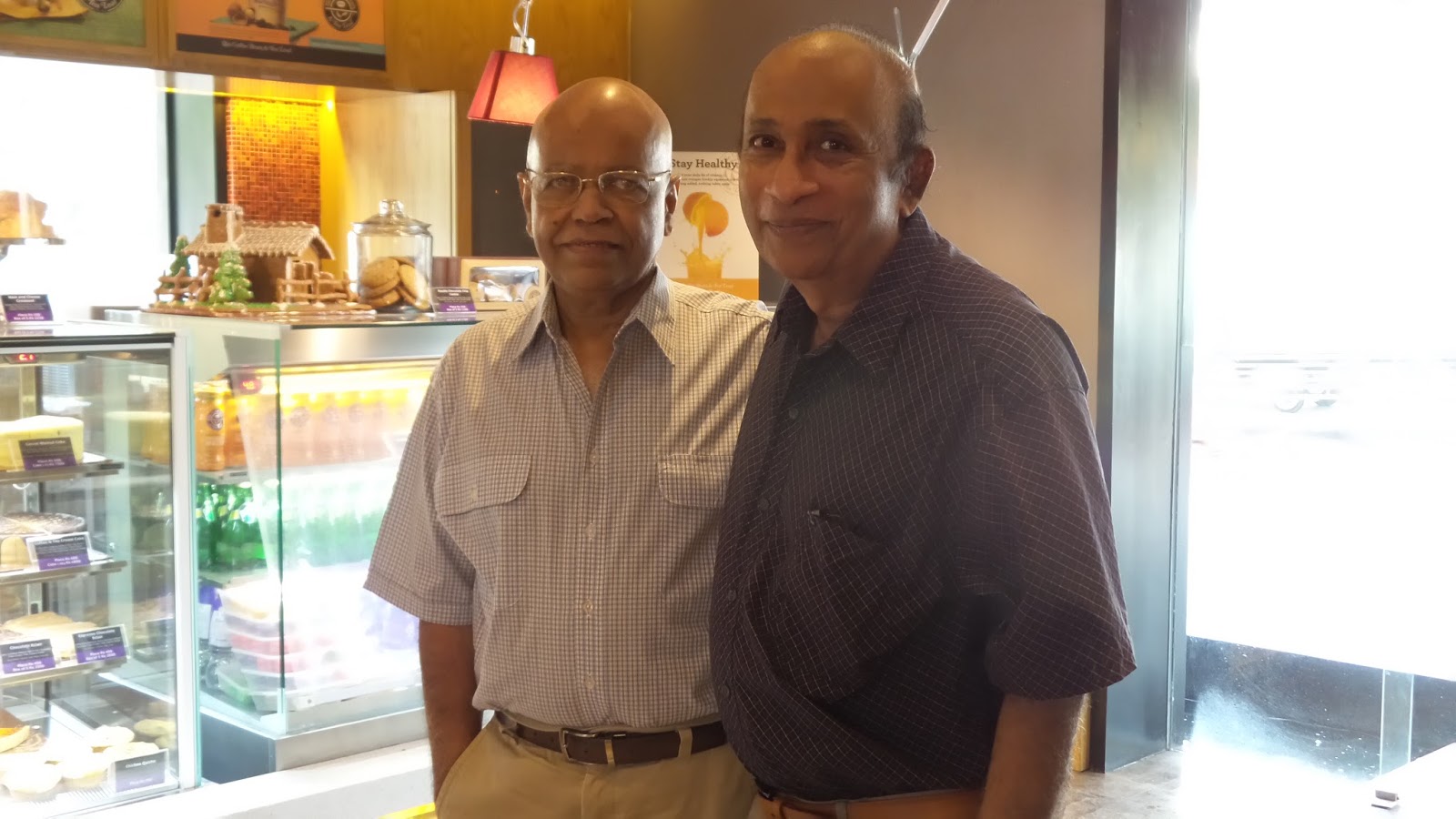
A few of us met at the Coffee Bean on Horton Place recently. Pram, Srianee (Bunter), Cyril and Kumar were present. My wife Mangala was also there. The expats are on holiday in Sri Lanka.

Cyril Ernest (Cardiologist in California)

Kumar Gunawardene (Cardiologist in Brisbane)
Bunter (Pathologist in CT)


These pictures were taken by Cyril.

Friday, February 5, 2016

Celebrating Sri Lanka

This e-mail was sent by Speedy. I previewed it and fully agree.

Dear Lucky,

CELEBRATING SRI LANKA

I don't often send you links to Youtube videos (other than my own!) but this one is worth publishing. It is one of the most beautiful, brilliant and innovative productions I have seen. Hope you agree.

"Celebrate Sri Lanka" is a project initiated by Berklee students from Sri Lanka in order to foster relationships between the Island Nation of Sri Lanka and Berklee College of Music, USA. The project which commenced at the LOFT, featuring guest artists Nalinda Pieris, Uthpala Eroshan and Dilhan Pinnagoda, all traditional Sri Lankan musicians based in New York


Speedy

Thursday, February 4, 2016

Creative Spot by Zita Perera Subasinghe


Acknowledgements:

I would like to thank Mahendra (Speedy) Gonsalkorale for taking a great deal of trouble in presenting this set of verses in the present form, using his skills in many fields and always being encouraging and helpful.


Many thanks, Lucky. I do appreciate what it must be to have us all sending 'this and that', asking for 'this and that' and you having to deal with it.
It's a massive job you are doing and we all appreciate it. I only hope more of our members take the opportunity to share things with the rest.  We would all welcome it so much.

Zita S.