Thursday, September 9, 2021

My exposure and experiences with astrology and Palmistry ND

My exposure and experiences with astrology and Palmistry

Dr Nihal D Amerasekera 

Palmistry or Cheiromancy originated in ancient India more than 5000 years ago and spread to China, Greece and Rome. Now, Palmistry as an art is practised worldwide. At present, there are three types of Palmistry, Indian, Western and Chinese.  The Western and Chinese Palmistry now show a significant divergence from the original Indian Palmistry. The Indian Vedic astrology is closely linked to the notions of karma. Palmists believe Palmistry is both a science and an art. Astrology originated in Babylon far back in antiquity around 2400 years ago. 

I grew up with my grandparents, both of whom were excellent palmists and astrologers. Friends and family got them to cast horoscopes and got their palms read. For them it was a hobby for which no money changed hands. When I was born at the Kandy hospital my grandma, was there with her watch recording the time of birth with accuracy. The local time in Ceylon was changed during World War II to what was called ‘War Time’. This caused enormous upheaval in the astrology community in getting the time correct for casting horoscopes. 

I grew up in a milieu with great belief in the ability to predict the future. We all had our astrological charts on rolled-up ola leaves.  My grandparents were well aware of its difficulties and shortcomings and also how, when and what information to divulge. My grandfather was a fine palmist and even when I was a young kid I was told that I will be a doctor and my future lies in another country. In retrospect, I am amazed how accurately he summed up my future. He predicted the lives of all my cousins, and in the fullness of years, I can acknowledge now, was done with remarkable accuracy.  I had a cousin who was my age and attended the local school with me. When I asked my grandpa about her future he never said a thing and never did. It brought us great sadness when she died tragically age 35. Were his predictions perfect? Not at all. He did get things wrong. Like all professionals, he had his own explanations for his mistakes. His clientele was family and friends. These errors came to light many years later and no one came to any serious harm. 

My grandfather did tell me that I had the perfect chart to be a good palmist. I did learn the basics from him. He often said “practice makes perfect” and that I should read palms regularly. I never had the inclination, the desire nor the time for it. There were too many other interests and distractions while growing up. Nevertheless, my interest in Palmistry never waned and lurked in a secure corner of my brain. I took it up again briefly after retirement just as a hobby. On a Mediterranean cruise I discovered Palmistry was a good ‘party trick’. The mere mention at the dinner table that I could read the palm generated great interest despite my disclaimer of being a novice. This indeed got the ladies lining up for their futures to be revealed. 

When I was a 1st-year medical student we visited a family friend in Kollupitiya. There was a large gathering. Amongst the crowd was a professional palm reader. They asked me if I want my palm read. Without much thought, I agreed and realised later that was a huge mistake. As there was an audience the palmist played to the gallery. Some very personal events of my future life were bared for all to hear causing me great embarrassment and distress. Much of the past was incorrect and in retrospect, the future predictions were a load of rubbish. In those days I wasn’t vocal enough and suffered in silence. I still blush when I think about it. This is an excellent example of how NOT to read the palm. There are many such unscrupulous quacks and rogues that hoodwink the people to earn a living. 

All palmists should learn the trade as an apprentice to a true professional who should teach them the art, obligations and the “bedside manner”.  Like in the Hippocratic oath they should be taught "primum non nocere ( first, do no harm). In my childhood I recall the village astrologers and palmists who frightened the people with impending doom and gloom and extracted money to counteract the forces of evil. Perhaps with increased literacy and learning these practices have now disappeared. It is my belief that like in every profession, for astrology and Palmistry too some have the special gift of instinct or intuition that set them apart from the rest. I have met a few of them who were brilliant professional astrologers and palmists who have made a name for themselves and make an honourable living. 

The art of predicting the future has always fascinated people all over the world. For a young person with all his/her life before them, there is that inevitable desire to know what is in store. Even In the 21st century that desire still exist. There are some who would say “why know the future, just get on with life”.  As a septuagenarian knowing the fragility of life I agree with that sentiment completely. Que sera sera - whatever will be will be. 

On a personal level, my future has been predicted with great accuracy and I have good reason to believe in both Palmistry and astrology. The accurate time of birth and proper casting of the horoscope is the key to its reliability. Even with all that the predictions are neither fool-proof nor flawless. Finding a genuine bona-fide palmist or astrologer is like searching for a needle in a haystack. 

There is a conflict between my scientific background and those imprecise and unregulated business of astrology and Palmistry. As a medical professional, I am trained only to trust evidence based information and have some cynicism and scepticism about matters I cannot prove logically. 

I never allowed my decisions to be guided by astrology or Palmistry. Those predictions have no guarantee of accuracy although it gave me a fairly clear picture of what the future held for me. I have lived my life as I wanted, making much of the decisions on the hoof. In the main I have no regrets. I have always believed that what happens to us in life is governed and influenced by the awesome forces of destiny.

Tuesday, September 7, 2021

PALMISTRY-- A Personal Experience. Sanath P. Lamabadusuriya

PALMISTRY-- A Personal Experience. Sanath P. Lamabadusuriya

In late 1971, when I was waiting to travel abroad for Post-Graduate studies, I decided to have my palm read by one Kingsley Goonetilleke, who was a well-known palm reader at that time. He had his office at Galle Road, Ratmalana. I had long hair at that time (JVP times!) and having parked my Triumph Herald car some distance away, I walked in with an unbuttoned shirt wearing a pair of slippers.  After accepting a fee of ten rupees, he daubed my right palm with Indian ink and got a print onto a sheet of paper. He asked me what my profession was and I replied that I am a bank clerk. He retorted that I cannot be a bank clerk and unless I assisted him he was unable to give an accurate reading. Then I told him that I am a doctor. He said that although I am a doctor I have to be involved in more activities rather than treating patients. When I requested clarification, he told me that I should be involved in teaching and/or research as well. I was a lecturer in the Colombo Medical Faculty at that time and involved in a lot of teaching and some research but I remained silent. He mentioned a few events of my past which were factually correct but wrong by a year or two. 

He told me that I was due to travel abroad very soon for further training and will return after a few years as a single person (not married). He went on to mention that I will eventually get married to a person known to the family. At that time I had no idea who my future wife was going to be. (My father was very happy with this particular prediction because he did not wish for me to get married to a foreigner !).He also predicted that I will become a professor before my 40th birthday. At that time it was not possible because Ceylon had only two medical schools in Colombo and Peradeniya and both its professors were due to retire in the early 1990 s (by that time I would be close to 50 years!). 

I travelled to London in late December 1971 and returned home single after three years. 

In February 1976 I married Buddhika Ediriwickreme which was arranged by my parents. Buddhika's father was a cousin of my father's and both of them hailed from a village called Pahalagoda off Tangalle. 

In 1976 during Sirima Bandaranaike's premiership, members of the opposition like Gamini Dissanayake made speeches in parliament mentioning that if and when they come to power they would abolish standardisation at the university entrance examination. After J.R. Jayewardene's resounding victory the government had to implement what they had promised earlier and standardisation was abolished. Then more Tamil students qualified to enter the two medical faculties which was not politically palatable. As a balancing act more Sinhalese students had to be admitted as well. When this was done there were insufficient slots for all of them in the two existing medical faculties. This resulted in the creation of two additional medical faculties in Jaffna and Ruhuna. When the Professor of Paediatrics post for the University of Ruhuna was advertised in 1978 I applied for it (I was the only applicant). After returning home from sabbatical leave in November 1979 I was appointed to the Chair of Paediatrics and I assumed duties on the 1st of August 1980 (I was 37 years and 7 months old on that day). 

Dear colleagues this is my very own experience with palmistry! 

Sanath P. Lamabadusuriya MBE

Emeritus Professor of Paediatrics

University of Colombo.

Sanath portrait by Nihal D Amarasekera

Thursday, September 2, 2021

SPEEDY DIALOGUE SERIES- EPISODE 10.CHIRASRI JAYAWEERA BANDARA (Instlament V)

SPEEDY DIALOGUE SERIES- EPISODE 10. WITH CHIRASRI JAYAWEERA BANDARA  (Instalment V)


Episode 10 (V) : Chirasri  Jayaweera Bandara
(nee Mallawaratchi)

“My achievements in Ophthalmology”

 Speedy: Good to see you again Chira. As agreed, let us talk about your special achievements in Ophthalmology

 Chira: Thank you again Mahendra for giving me this opportunity to talk about some of my achievements.

Speedy: Chira, we all know a lot about you after the previous episodes and how you became such an eminent Ophthalmologist in Sri Lanka. We are all very proud of you. 

Chira: Thank you, Mahendra for your kind words.

.Speedy: OK Chira, after obtaining your qualifications, you came back to Sri Lanka in May 1979 and was appointed   Consultant Eye Surgeon, Kegalle Hospital. When our good friend Cassim got transferred to Eye Hospital from Kandy Hospital, you got a transfer to Kandy Hospital in Oct 1979.

 Chira: That is correct. 

Speedy: And you worked in Kandy for 5 years and came to Eye Hospital Colombo as Consultant Eye Surgeon in Oct 1984 and retired in Feb 2001.             

Chira:  Yes, those were my Consultant posts in Sri Lanka. 

Speedy;  Good. We know that you developed special expertise within Ophthalmology. Tell us more. 

Chira: I went with other Consultants to Hyderabad and Madras to follow workshops on Cataract Phaco emulsification Surgery in 1999. This is the latest technique to remove a cataract by emulsifying the cataract and aspirating it with the Phaco machine. 

Speedy: You also gained more expertise when you had several spells in the UK after you became a Consultant. What is the background to this and when and where did you work?   

Chira: While working in Govt.  Service  we  were  entitled  to  take  6  months overseas  leave  every  5 years. I made use of this and  worked   in  the U.K in the  latter  halves  of  1986,  1992  and  1998.

Going to the U.K helped me to get special experience. For example, in 1986, I learnt the use of the LASER and obtained experience in Laser treatment. At that time Sri Lanka did not have a single Laser machine. When I was the President of the Ophthalmological Society of Ceylon in 1987, I started a Laser fund and organised several fundraising programmes. 

And also working in UK in 1992 and 1998 as a Locum Consultant I gained experience with more modern and advanced instruments and techniques which helped me to purchase certain items and improve my techniques in Sri Lanka. 

Speedy: I can see how you made good use of these overseas opportunities to gain specialist experience in Ophthalmology.

You indicated to me that the late Dr Sivasubramanium was a special influence in your career. Can you tell us about him and how he helped you?

Chira:  He was a truly great man Mahendra. He was the first Sri Lankan to obtain the FRCS England in 1950 and he is rightly considered the Father of Ophthalmology in Sri Lanka.

Speedy:  I wasn’t aware of that. That is certainly a milestone in your speciality. Did he also think highly of you?

Chira: Yes he did. Dr. Sivasubramaniam used to attend every single meeting and every single Annual Congress of the Ophthalmological Society earlier, and later the College of Ophthalmologists of Sri Lanka after it was formed in 1992. He was the founder President of the College. He was a keen participant and observed the happenings carefully and formed his own opinion.

I received a letter from Dr Sivasubramanium in 1992 when I was in UK. 

Actually it was a very long letter; I have combined the beginning and end. Here it is.                                                

Speedy:   I note he says in this letter that you have impressed him as a dedicated Eye Surgeon and a teacher. That was high praise! No wonder you treasure it.

Chira:  Yes Speedy. I was so thrilled when I received it. 

Speedy: He has also said that you have done miracles and marvels.  Why do you think that he said that?

Chira: I think it was because I have done corneal surgery where others haven’t.

Speedy: You dared to venture into uncharted territory so to speak. So you were a pioneer in that field in Sri Lanka?

Chira:  Yes, I was.

Speedy: Dr Sivasubramanium showed his appreciation by giving you something with, a label pasted on top saying “to a gifted colleague who excels in surgical handicrafts”.                                          

Chira:  Yes, he did. . He gave me his Keratoplasty instruments box with my name written on top and also all his published papers in the British Journal of Ophthalmology, with the note you mentioned pasted outside.                             

Speedy:  You must have been so happy.

Chira:  I couldn’t believe my eyes when I saw it, coming from a great person as Dr Sivasubramaniam.

I treasure it.

Speedy: Leaves us in no doubt on what he thought of you. 

Let us discuss some of your special work in the field of eye surgery. I am not very good on technical terms in your field but you mentioned Keratoplasty. I hope that I got that right.

Chira:  Keratoplasty, Mahendra, is a corneal transplant. It is a surgical procedure to replace part of your cornea with corneal tissue from a cadaveric donor. I have done Penetrating (full thickness) keratoplasties (PKP) on  Hypopyon (pus in the anterior chamber) ulcers.

Speedy: Sounds very complicated Chira!

Chira:   Not really, once you get trained and acquire the necessary skills.

At that time no one dared to do a P.K.P. on a Corneal Ulcer with pus in the anterior chamber. I took up the challenge and did 35 PKP on such eyes and read a paper in 1989 at the Ophthalmological Society Congress. Dr Sivasubramaniam who was present said it was very good and fit for an oration. I managed to save all these eyes with good vision; otherwise, they would have lost their eyes.

Left side: Before surgery. Corneal Ulcer with Pus in Anterior Chamber,

Right side After Keratoplasty

Speedy: Most impressive Chira. What are the other types of grafts you did?

Chira: I did Freehand Keratoplasty. 

I read  papers in 1982,  1993,  1994,  1996  at our Annual Congresses and also at the  S.A.A.R.C.  Eye Surgeons Congress in 2000.

I did  freehand  lamellar  (partial  thickness),  freehand   penetrating (full  thickness) and freehand combined  keratoplasties .

Speedy: Not sure what you mean by “freehand”. Could you please clarify?

Chira: Sure. Freehand keratoplasty is where the Surgeon cuts the donor cornea and the patient’s cornea freehand without using the usual circular trephine.

Speedy: I understand now.

Chira: When the lesion is in the periphery of the cornea near the limbus the usual circular trephine cannot be used.  Freehand keratoplasty is then required and is very difficult to do. It is time-consuming and a lot of patience is needed.  I devised this on my own and tried with success as no one had done this before. I have saved these eyes by doing freehand grafting.

For your interest, I will let you know that I used sterilized paper first and later on cotton material to fashion out the patient’s cut and also the donor eye cut. The donor corneal strip may be bean-shaped, crescentic, horse-shoe or oval-shaped depending on the lesion. This is sutured to the patient’s eye.

These are seen in the Freehand grafts I did below.. 

(For each set, pre-op on the L and post-op on the R)


Speedy: All those eyes looking at me! Yes, Chira do carry on!

Chira: I read 3 papers at the S.A.A.R.C. Eye Surgeons Congress in 2000.

The first was on Keratoplasty on Keratoconus (Conical cornea where usually teenagers present with very poor vision).

I did   102   PKP over a period of 5 ½ years with   excellent results. I followed  them  for  more  than  5  years  and  I had  to  repeat  only  one,  with  very  good  results.   No  one has done  102  PKP  on  keratoconus  in  5 ½   years  in  Sri  Lanka  and  I  don’t  think  even  abroad.

Speedy; That is simply amazing!

Chira: Yes, I am quite proud of it. While on the subject Mahendra, this reminds me of a special case. There was a medical student (now a doctor) I did. His other eye was done by a graft surgeon in the UK. The keratoconus eye I did was much better with a perfect graft with 6/6 vision. This patient’s uncle is Kariyawasam our batchmate. He had got him to the U.K to get the graft done.

Photo below shows a Bank Manager’s bilateral PKP done on Keratoconus.

This Photo taken 10 years later, shows perfect grafts (the surgical trephine cut is hardly seen) with 6/6 vision.                                                                                           


The second was on the usefulness of Freehand Lamellar Keratoplasty in Marginal Ulcers.


This marginal ulcer patient had a horse-shoe shaped donor corneal strip.


The third was on Keratoplasty in complicated eyes.


This was an only eyed acid burns patient who was blind for 21 years. Was refused treatment by many eye surgeons. I took up the challenge and did a total lamellar keratoplasty. Patient was thrilled, he was able to see his own 9 year old son for the first time, after he was born. This appeared in the Lakbima newspaper on10.12.2000. 

Speedy: That was great. What about your papers presented at congresses?

Chira: I have read many papers at our annual congresses.  PKP in Fungal Suppurative Keratitis, PKP and Scleral fixation IOL (Intra Ocular Lens or Implant is sutured to the sclera), are a couple of them

Speedy: I see. Keratoplasty was something you were very good at. Any statistics on that?

Chira: in  my  unit  at  eye  hospital,  on  an  average,  180  grafts  were  done  per  year.  In  my  study  the highest  number  of  grafts  were  done  on  corneal  ulcers  -  28%

I  have  done  about  30  grafts  on  Pakistani  patients  and  about  the  same  number  of   grafts   on   local patients at  Nawaloka hospital.                                            

Patients have been referred to me for grafting   by   consultants from Colombo and from all   over   Sri Lanka. 

Speedy. Shall we now talk about some of your achievements in Ophthalmology?

Chira:    Sure. I shall start with my post-graduate qualifications. Firstly, the Diploma in ophthalmology D.O. (Lond) which I obtained in 1977. Next, I got the Fellowship of the Royal College of Surgeons F.R.C.S. (Eng) in1978. I obtained my F.R.C.S. Ophthalmology Eng. in 1978.  It was conducted by the Royal College of Surgeons England

Speedy: What was the status in Sri Lanka, were there any specialist programmes conducted? 

Chira: Only later. The College of Ophthalmologists England was formed and they started conducting Ophthalmology exam. Those who obtained F.R.C.S. Ophthalmology England were awarded the F.C.Ophth.U.K. Certificate. I was awarded F.C Ophth. U.K. certificate in 1989.

Speedy: With the commencement of the PGIM (Post Graduate Institute of Medicine, Colombo), were you recruited to help?                            

Chira: I was quite involved with the PGIM) and was very happy to help.

Speedy: What were your duties there?                                        

Chira: My duties are best summed up as, Member Board of Studies From 1985 to 2001, Examiner for D.O. Ophthalmology From 1983 to 2001, Examiner for M.S Ophthalmology From  1985 to 2001, Tutor in Ophthalmology From 1989 TO 2001, Undergraduate Trainer in Ophthalmology From  1979 to 2001 and Postgraduate Trainer in Ophthalmology from 1983 to 2001.

I was in the MCQ core group and we used to meet once a week to form MCQ for the MCQ bank.

May I add that I was  President of the  Ophthalmological Society  of  Ceylon  in  1987 and of the      College of  Ophthalmologists  of  Sri Lanka  in  1999 and  2000.


Photo taken after  the  Induction  in  1999 (Cassim and  Late J.G.Wijetunge are in the Photo)

Speedy: Those were singular honours Chira. It is tremendous to see a Batchmate achieve so much.

Chira: Glad you think so. I was always keen to help Medical Education in Sri Lanka.

Speedy: You have set a very good example, no doubt. Moving on, corneal grafting was clearly your main interest.        

Chira: Yes Mahendra. I  do  not  think  that  anyone  has  done  so  many  grafts  as  myself  at  that  time. That  may  be  the reason I  received  two  awards  on  grafting.

The first  From The  Lions club in  1995/96  An appreciation award for services rendered to the “sight  for thousand programme” and the second from The  Sri  Lanka  Eye  Donation  Society  in  2004,  an award in recognition of the  invaluable services  rendered to the society for grafting human corneas for patients in Sri Lanka.  

Speedy: I am aware that you won many other awards. Would you mind listing them?

Chira: Sure. I am proud to say that I received a President’s Research award from Mrs Chandrika Kumaratunge in 2000. And In 2002, I was awarded Honorary Fellowship of the College of Ophthalmologists of Sri Lanka.

Another proud achievement was being invited to deliver the Prestigious Dr P. Sivasubramaniam Memorial Oration on 3. 9.  2011.

Memorial Oration at the Galadari  Hotel,  Colombo.                                                                      


                                       With my family after the oration including my daughter in Law                                                              

College of Ophthalmology  President’s  Medals  1999 and  2000

Dr Sivasubramaniam Memorial Oration  Medal  In front           


I also received an Outstanding Health Professional Award  from the Sri  Lanka  Medical  Association  on the International Women’s day   8. 3. 2012.


Group Photo        Prof. Priyani Soysa,  Suri  are  also  there.


Awards   On left side Award  from Eye Donation Society,  Centre  Award From Lions club,   

right side Outstanding Health Professional  Award  from S.L.M.A.   Circular award  from Methodist College, felicitation by O.G.A.                                                                                                        Speedy: Very impressive! Very impressive!

Chira: Not  only  did  I  have  achievements  in  the  field  of  ophthalmology    but  also for other Achievements at  the  Eye  Hospital.

Speedy: These I presume were of a more broad nature?

Chira: That is correct. For example, I arranged to refurbish Wards 7 and 8. We collected  about  Rs  300,000  from  donations  from  patients  for  floor tiles. These wards were the first to get floor tiles in the whole hospital. Further improvements such as colour  washing  the  walls,  new  fluorescent  lights,  new  curtains,  pictures  on  the  walls, providing the Nurses  duty  rooms  with  illuminated  Snellen charts.

Speedy: All very useful and much appreciated I am sure.

Chira: Yes, you can say that. Furthermore, when I was President of the college, I arranged the refurbishment of the lecture hall at Eye Hospital Colombo. Meetings of the  College of  Ophthalmologists of  Sri   Lanka are held at this lecture hall. A public address system with 4 speakers was also installed. New fluorescent lights and  3  dimmer lights were fixed, a podium and  2  additional stools were provided. A Magiboard was fixed at the centre and 2 screens 5’ x 5’ were fixed for double projection. Colour washing was done and new curtains were fixed.    

Speedy: What about all these photographs of famous people you showed me?

Chira: They are to do with another innovation I made. I  started  a gallery of photographs of the  Past  Presidents  of  the  College  in  the  College  room, (which I opened before),  in the Eye Hospital, Colombo.

College Room Photographs  hung                        

Late  Dr.  Sivasubramaniam, Dr. Wirasinha, Dr. Mendis and Dr.(Mrs).Stephen are seen in the photo. Cassim’s and my photos are  seen hanging on the wall.

Then I  got the idea of having the photographs of retired  Consultants,  Eye  Hospital, Colombo,  hung   according  to  seniority  in  the  lobby  outside the  lecture  hall, Eye  Hospital,  Colombo.


This Photo  is in the lobby outside  The Lecture hall,  Eye  Hospital, Colombo.

Speedy: This is quite a common practice in the Royal Colleges in the UK and it is a good way of honouring them and recognising the service they gave. I am so glad that you did this. 

There is another important duty for Consultants and that is to be Trainers. As a consultant, you must have had responsibilities as a Trainer. Why don’t you tell us a little bit about that? 

Chira I have trained a large number of Ophthalmologists who are consultants now in Government service and in the Private sector. They are doing well.  Three of them invited me as  Chief Guest at our College Banquet when they became Presidents of the College. The third one invited me one year ahead as he became Vice President.  I  said  I  have been  Chief  Guest twice and to think of inviting someone else,  but he insisted, and so I was Chief Guest thrice!

Speedy: Isn’t it nice to be wanted! I am sure they were honoured to have you. And how good to know that your daughter is following in your footsteps

Chira: Yes, I am very proud of Anjali. She will be a consultant eye surgeon like her mother when she is board-certified after her post-M. D. training one year in Sri Lanka and one year overseas. 

Anjali and myself at college congress 2019                         

 .

Speedy: That’s great! Chira, we are all very proud of you, our Batchmate who has achieved so much and done so much for improving the speciality of Ophthalmology in Sri Lanka. It was good to know that your efforts were appreciated. I had no idea on the scope and extent of work you have done and it was a great pleasure to hear of your achievements. 

Well done Chirasri  Jayaweera Bandara. Consultant Ophthalmologist,  proud daughter, wife and mother, a true servant of Sri Lanka. 

Chira: Thanks very much Mahendra for your kind words of appreciation. Do I deserve all that praise!

Speedy: Of course you do Chira! You were a bit bashful to talk about yourself but I am so happy that you put that aside and shared your happiness with us. I enjoyed this session a lot and I am glad to have given you the opportunity. 

Chira: Thanks Mahendra, I really enjoyed it too. You have taken a lot of trouble and I appreciate very much your effort.  I am ever so thankful to you for being so patient, so caring and spending a lot of time preparing this difficult interview. Thank you for giving me this opportunity and I hope that the Blog will continue to flourish. All the best!

Speedy: It has been my pleasure and thanks again for sharing.  Your tea was lovely too but then there is nothing to beat Ceylon Tea!    

Sunday, August 29, 2021

Customs and Traditions- Srianee Dias

CUSTOMS AND TRADITIONS

Srianee Dias


Certain events and experiences in the recent past have focused my thoughts on a topic which has been buzzing in my brain for some time.  There are certain customs that we observe at various stages of our life without pausing to question because “That’s the way it has always been done!”  Often the elders in our family circles coerce and pressure us into following these customs and we cave in!

Yuval Noah Harari writes in his book “Sapiens” (recommended reading, by the way!) how Homo sapiens controlled the behaviour of their species by inventing “imagined realities.”  Our ancestors developed myths which resulted in diverse behaviour patterns, what we now call “cultures.” For example, the myths of the divine rights of ancient kings and the power of tribal leaders.  This led to rapid cultural evolution among Homo sapiens depending on the changing needs of the species.  “The imagined order is embedded in the material world” writes Harari.  We created these cultural “rules.” They are not part of our natural DNA. 

In contrast, the social behaviour of other species is determined by their DNA and the environment.  Most animals living in specific environments behave in ways similar to other members of their species, (e.g. Chimpanzees, elephants, birds, etc.) 

On my recent visit to the Amish country in Lancaster, Pennsylvania, I observed the very strict, restrictive customs that the Amish people still observe, dating back to the 1700s, in spite of being surrounded all around by the advances of the modern world.  I was especially struck by the rules that governed women’s attire.  There is something to be said for living a simple stress-free life, but I am not at all certain if all those rules and restrictions result in reducing stress! 

All of us who were born in Sri Lanka grew up immersed in a culture that went back many centuries. Our lives were influenced by customs originating in many cultures; Kandyan, Low country, Tamil, Portuguese, Dutch, British and even American, some of us more than others.  Religious traditions have also been enmeshed with the secular. 

Those of us who emigrated to lands far away from our birthplace have tried to observe some of those customs and traditions to the best of our capabilities, such as celebrating the traditions of the Sinhala and Tamil New Year. Recently I heard the phrase “You don’t leave your country; you take your country with you.” I believe it was expressed by a guest speaker at one of the SLLS Zoom meetings, and it rang true based on my experience. 

Our customs are often adulterated with superstitions and sometimes dictated by astrologers, which has its drawbacks. In my opinion, any custom which is detrimental to any sector of the population needs to be discontinued.  (I suspect that some people will vehemently disagree with me!) 

There are some traditions that are charming and definitely worth handing down to future generations.  I love the tradition of showing respect to elders following the traditional poruwa ceremony at weddings, when the bride and groom offer bundles of betel leaves to their parents, getting down on their knees and bowing down in front of the parents. There was also a time when betel leaves were offered to elders when someone visited the home of an older family member or teacher, but I don’t believe it is being done anymore. 

In the villages of Sri Lanka, and perhaps India, there is a tradition of offering a glass brimming with water to the chief guest at an important luncheon, such as at a wedding. I believe it is a symbolic invitation for the guests to begin the meal that is being served.  This tradition may also be fast disappearing. 

It is at weddings that traditions come creeping out of the woodwork.  An interfering aunt (usually!) will begin dictating the “should” and the “should nots” to the bride and groom, and their parents. 

I have sat through a 3 hour long Hindu wedding ceremony in the US where the guests kept getting up from their seats, taking turns to stretch their legs, paying very little attention to what was going on.   I have also attended a well-choreographed, abbreviated version of the Hindu ceremony where the considerate bride and groom had a friend participating on the side giving brief intermittent explanations of the significance of what was taking place, for the benefit of the (mostly non-Hindu) guests. 

A few years ago, when I was in Sri Lanka, I was invited to a family brunch to celebrate the occasion of my grandniece “attaining age,” Accepting the fact that in Sri Lankan culture it was an event often celebrated, I joined the family and sat down to enjoy the goodies which included some of my favourites, kiribath and lunumiris!  In the course of conversation, I learned that my grandniece had been kept away from school for a whole week!  I almost choked on the kiribath and asked why she wasn’t sent to school?  What if she had an important exam that week?  The sheepish answer I received from my sister-in-law (the grandmother) was “We have to follow our traditions!” I countered with my argument that the only traditions that are worth following are those that make sense.  I’m not sure if I got through to anyone that morning, but I was thankful that my sister-in-law does not have any more granddaughters! 

I know that among the hill country Tamils the families get into debt to have grand “coming of age” celebrations that they cannot afford.  But, when my educated sister-in-law, who should know better, blindly followed this ancient ‘tradition’ which could have a negative impact on young girls, I was appalled. 

In the old days, it may have made sense for girls to be secluded this way because they did not have access to modern sanitary products.  But there is absolutely no reason for girls to miss one week of their education in 2021, unless they are feeling unwell.  I hope this is one tradition that will be tossed out soon. Doctors need to educate their patients too, because after all this is just a physiological change in a young girl’s life.  All she needs is the information and the guidance to be well prepared for the event. Perhaps there are other similar traditions of which I am completely unaware. 

To borrow a few lines from the Kenny Rogers song “The Gambler”

              “You’ve got to know when to hold ‘em, know when to fold ‘em, know when to walk away and know when to run!”

I would love to hear from my friends about other traditions we need to “hold” and those which we need to “fold.”

Wednesday, August 25, 2021

Nihal (ND) Amarasekera on fascinating “flying things”

Nihal (ND) Amarasekera on fascinating “flying things”

Butterflies


Butterflies reminds me of our study of these magnificent insects in biology and its transformation from a slimy voracious caterpillar to an inactive sedentary pupa and then to a beautiful and colourful butterfly flitting from flower to flower. They have mesmerised humans by their delicate elegance and charm since time began and remains so still across cultures as a symbol of the beauty of nature.

Victor Hugo was a famous French romantic poet and novelist in the 19th century (known for The Hunchback of Notre-Dame) and Les Misérables (1862) both rather sombre and dark stories but he also wrote a bright and lovely poem about butterflies.

 The Genesis of the Butterfly by Victor Hugo

The dawn is smiling on the dew that covers

The tearful roses; lo, the little lovers

That kiss the buds, and all the flutterings

In jasmine bloom, and privet, of white wings,

That go and come, and fly, and peep and hide,

With muffled music, murmured far and wide.

Ah, the Spring time, when we think of all the lays

That dreamy lovers send to dreamy mays,

Of the fond hearts within a billet bound,

Of all the soft silk paper that pens wound,

The messages of love that mortals write

Filled with intoxication of delight,

Written in April and before the May time

Shredded and flown, playthings for the wind's playtime,

We dream that all white butterflies above,

Who seek through clouds or waters souls to love,

And leave their lady mistress in despair,

To flit to flowers, as kinder and more fair,

Are but torn love-letters, that through the skies

Flutter, and float, and change to butterflies

 Oriental Magpie-robin


These birds are found in the Indian subcontinent and South-East Asia. They are so easily identified with their long tail and black and white plumage. They are commonly found close to human habitation as birds in our gardens feeding on insects, scraps of food, rice and seeds. They make their nests in holes in trees.

The Eurasian Magpies are known for their intelligence. They are much larger and more aggressive feeders stealing eggs and young from the nests of other birds and hence disliked by many. According to traditional British folklore the Magpie is linked to the devil. These birds are grouped with the crows as evil as shown on the film “Omen”. Magpie is the national bird of Korea adored and revered by many as the bringer of good fortune.

 The House Sparrow


These lovable little creatures are ubiquitous and is often described as the cheerful exploiters of man’s rubbish and wastefulness. Having colonised human habitation throughout the world is a common garden bird we all have seen and loved all through our lives. We often left pots with a hole in the centre on trees in our garden for sparrows to nest and they did. Many consider them a symbol of good luck. These cheerful and gregarious little birds prefer to live close to each other in large flocks. They are sometimes seen having baths together in ponds and streams. We often see large flocks congregate in trees in the evenings at sunset and also at sunrise. Sadly these birds are in decline worldwide due to habitat loss.

I love this simple poem by Charles Lamb (1775-1834), the 19th century poet.


The Rook and the Sparrows by Charles Lamb

A little boy with crumbs of bread

Many a hungry sparrow fed.
It was a child of little sense,
Who this kind bounty did dispense;
For suddenly it was withdrawn,
And all the birds were left forlorn,
In a hard time of frost and snow,
Not knowing where for food to go.
He would no longer give them bread,
Because he had observed (he said)

That sometimes to the window came
A great black bird, a rook by name,
And took away a small bird's share.
So foolish Henry did not care
What became of the great rook,
That from the little sparrows took,
Now and then, as 'twere by stealth,
A part of their abundant wealth;
Nor ever more would feed his sparrows.
Thus ignorance a kind heart narrows.

I wish I had been there, I would
Have told the child, rooks live by food
In the same way that sparrows do.
I also would have told him too,
Birds act by instinct, and ne'er can
Attain the rectitude of man.
Nay that even, when distress
Does on poor human nature press,
We need not be too strict in seeing

The failings of a fellow being.


Sri Lankan Jungle Fowl (Gallus lafayettii ) 


Our jungle fowl is endemic to Sri Lanka and is our national bird. This is one of the most beautiful birds we have with a richly coloured plumage and a comb of brilliant red. As the name implies they are commonly found in the jungles but occasionally close to human habitation. Although uncommon they are known to inter-breed with domestic fowl. The jungle fowl live in area upto 2000 metres above sea level in the jungles of Kitulgala, Yala and Sinharaja forest.


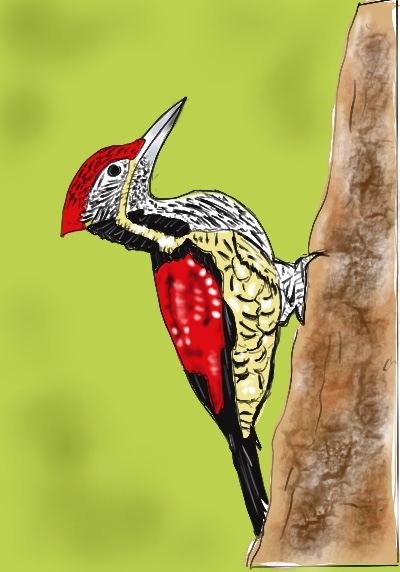
Woodpecker


There are several type of woodpeckers in Sri Lanka. The red coloured flamebacks are only found in Sri Lanka and the Philippines. They feed on insects mostly ants, beetles and caterpillars and also arthropods like spiders. Woodpeckers drill nest holes in trees. Romans worshipped the woodpecker. Picus, was a woodpecker  sacred to the God of Mars.

(all drawings by Nihal. Photos of Victor Hugo and Charles Lamb from  the Web)

Sunday, August 22, 2021

I am going home

 “I am going home”

Mahendra “Speedy” Gonsalkorale

How many times have you heard this said, but have you really wondered what these four simple words mean? It is easy enough to directly translate, isn’t it? Well, as you may have guessed there is a twist in the tail. It is with reference to that simple word “home” and I would like you to pause for a moment and….. think..

Home could be the place where one lives permanently, especially as a member of a family or household.

It could be a place of residence, accommodation, a roof over your head, quarters, lodgings, rooms, address, location, residence, abode, dwelling etc.

It could refer to the country you live in now or The country you were born and lived a significant part of your life.

It could be an institution for people needing professional care or supervision, such as residential home, nursing home, old people's home, retirement home, convalescent home, rest home, children's home etc.

It could be a place of shelter, refuge, a retreat, an asylum or hostel.

The feeling of belonging to a home is strong in the animal kingdom. An animal who returns by instinct to its home territory after leaving it has a homing instinct, e.g.,“a dozen geese homing to their summer nesting grounds"

Yet another use of the word home  is the central importance attached to the term home physically as illustrated by moving or aiming towards the most important place in the target or destination- aiming home. There is a similarity here, as home is of central importance.

For most of us, Home means an enjoyable, happy and safe place where you live, laugh and learn. It's somewhere where you are loved, respected, and cared for. When you look at it from the outside, your home might just look like an ordinary physical structure – but home is more, much more than a mere physical structure.

We take for granted what a home is. Like many things we have, we most appreciate it when we are not at home. Even when you are in a strange place, if you feel comfortable, you say you felt quite at “home”.

We forget the millions who have no home. Just think of the terrible situation in Afghanistan. Just think of helpless innocent children who are homeless. Just think of some psychologically and mentally disturbed people who live on the streets – the homeless.

We look back on our Faculty days and for many home could have been a hostel or rented room. When you are away from the Hostel like at a party, going home means going back to the hostel which is now your home. But if you have a parental home, that is what you refer to when you say I am going home. When I was an HO at GHC, I lived in Regent House and my room there quickly became my home and my mother was puzzled by my desire to go back there rather than sleep overnight at Nawala. Regent house, and in particular my room, was then my home!

When I went on holiday from England to visit my parents’ house at Nawala where I used to live, I was going back home. But when the holiday ended and I left for England, I was also getting back home!

A home is important for mental and social stability. A home must be a place of safety where you can lower your guard and relieve yourself from anxiety, stress and fear. You are even luckier if you have a loved one/s with you to share the home.

If you live abroad, is your home that country or the country where you were born and bred; where you were transformed from a tiny fertilised ovum to a functioning human being through an intermediate state of utter helplessness totally dependent on your loving parents? And now, here you are with memories, both pleasant and unpleasant, fears, anxieties, survival skills, education, knowledge, beliefs, opinions friends, associates etc. What seems to matter is the here and now.

Home is something some never had, not in its true sense. To us, the Medical Faculty all of us attended was indeed a kind of home. Our home need not be the same one over time; it can change from year to year or even in the same day. But all my homes, from childhood through school days, medical student days to all the physical places I occupied after becoming a doctor in different countries, are of importance to me.

Home is special. That is why, wherever you were out during the day or the week or the month or the year, the sense of relief, joy, the happiness you experience when you reach the front door, turn the key, open the door and let yourself in, is so joyous, so comforting, so “womb-like”, because your current home IS your home.

Man still preserves some characteristics derived from his history as a vulnerable being fighting to survive in an unpredictable and dangerous environment. The one place he feels safe is his home. It is possibly also the only place in his world he can make changes that are personal. It is therefore not surprising that he feels safe and happy in this “world within a world”. Anybody who suffered from the unpleasant experience of being burgled will understand the feeling of revulsion experienced at the mere thought that your personal space, your home, has been violated.

I wonder whether my thoughts on home have any connection with the pleasure gained by reminiscing on our "home", the medical faculty at a crucial stage of our lives. I wonder…I just wonder…Do you?