Showing posts with label Speedy Dialogues. Show all posts

Monday, June 20, 2022

Doctors as Artists - Mahendra and Chirasri

 DOCTORS AS ARTISTS

A discussion between Mahendra (Speedy)  Gonsalkorale and Chirasri Jayaweera Bandara.

Speedy: This article was prompted by comments that appeared in your beautiful bird paintings post Chira, in response to my question “I was wondering whether all good surgeons are also good artists. What do people think?”

Chira: I know Mahendra and thanks for developing that theme and coming out with this dialogue.

Speedy: Ok, here we go!

I was trying to see whether there is a common underlying skill, as both require dexterity and imagination. I looked at the published literature and found some interesting articles. When we consider “art” as a broad heading it would include painting, etching sculpture and also literary skills such as poetry and writing. Here we are concerned mainly with painting.

I would recommend a very informative article, “Physicians as Painters” by Avi Ohry MD Department of Rehabilitation, Reuth Medical Center, Tel Aviv, Israel Affiliated to Sackler Faculty of Medicine, Tel Aviv University, Ramat Aviv, Israel Keywords: medicine, art, poetry IMAJ 2003;5:681±684.

The following quotes are from the above publication.

It seems that close and creative relationships existed between physicians and painters. Examples include the great poet-physician John Keats (1795-1821) and Joseph Severn; Francois Joseph Talma (1763-1826) ± physician-actor whose friendship with the famous painter David led to Talma designing historical costumes for the theater; the friendship between the poet-writer-surgeon-satirist John Wolcot (his pseudonym was Peter Pindar) (1738-1819) and the painter John Opie (1761-1807 . Van Gogh`s physician, Paul-Ferdinand Gachet, was known as the impressionist painter's patron. Dr. Paul Alexandre (1881-1968), Dr. (dentist) Maurice Girardin (Paris, 1884±1951) who left 420 paintings to the city of Paris, and Dr. Albert Barnes (Philadelphia, 1872-1951) were physicians and art collectors.

Let us focus our attention on physician-painters. Curiously, both professions share the same patron saint. St. Luke, born in Antioch, was known to have been a Greek physician who accompanied Paul after the ascension of Jesus.  . Krateuas (or Crateuas), who lived in the first century, was a physician to Mithridates VI Eupator, king of Pontus. He was known as a physician, actor, chemist, and painter. He described and illustrated plants using natural colors, and some fragments of his works are included in the Anicia Codex of Dioscorides housed in the Vienna State Library.

One of the great Dutch painters, Jacob van Ruisdal (1682-1629) from Harlem (his real name was Izack de Gooyer), was a physician in Amsterdam . William Thorenton (1759-1828), born on Jost van Dyke Island (today the Virgin Islands), was sent to Edinburgh and Aberdeen to study medicine.

Francois Emile Camus (Dijon, 1829-1893) was a physician and sculptor who worked with bronze. Georges-Alexandre Chicotot, one of the first French radiologists, mostly painted medical paintings or scenarios. Paul Louis Collin, born in Thorigny in 1834, was a physician and painter who worked with Courbet. He mainly painted landscapes and still-life. Frederic Estre (Marseille, 1813 and Reuilly, 1902) was a psychiatrist and painter His paintings were exhibited all over Europe.

In England, John Leech (1817-1864), educated at Charterhouse, began his medical studies at St. Bartholomew's but turned to art. His teachers were aware of his talent and urged him not to restrict himself to anatomic drawings but to do portraits as well

Sir Francis Seymour Haden (1818-1910) was an English etcher, writer and successful surgeon in London who founded a hospital for patients with incurable diseases. 

William Rimmer (1816- 1879), whose father claimed their family was directly linked to the French royal family, was born in Liverpool and raised in Boston. He was the first American artist to sculpt the nude figure. His paintings were varied in subject matter, including historical themes, portraiture, biblical subjects and romantic visionary fantasy.

Henry Lamb (1883-1960), born in Adelaide in South Africa, studied medicine at Manchester University Medical School and at Guy's Hospital before taking up painting.

Here is an abstract of an article by Professor WIC Morris.

In "The Doctor's Dilemma," Bernard Shaw suggests that there is more antagonism than attraction between the doctor-scientist and the painter. The average doctor may, however, make some claim to be an artist. In his professional work, art plays some role, even if it is restricted to that much maligned professional accessory the bedside manner. Doctors in their hobbies sometimes display a wider taste in art-for instance as painters or collectors. The medical text-book has always required skilled illustration to make intelligible a letterpress which has not always been artistic. Many works of great medical importance owe their lasting fame as much to the perspicacity and skill of the illustrator as to any other inherent merit. DOI: https://doi.org/10.2218/resmedica.v2i1.330

The following quote by Janet Seggie in “Medicine and the humanities - doctors as artists” was quite interesting,

The clinical gaze [has] much in common with the artist's eye” - M Faith McLellan

http://www.scielo.org.za/scielo.php?script=sci_arttext&pid=S0256-95742014000200001

According to Martha Fleming, 'Artists and doctors share highly developed observational skills and a fundamental love for humankind'.  (Fleming M. Looking and Healing: Artists and their Doctors. Lecture Seminar, Centre for Humanities and Health, King's College London, UK, 2012. http://www.marthafleming.net/looking-and-healing-artists-and-their-doctors)

Speedy: The following story will appeal to Ophthalmic surgeons like you, Chirasri.

Dr. Jaclyn Gurwin, a third year Ophthalmology resident at the University of Pennsylvania’s Scheie Eye Institute, has been drawing and painting since a young age. Her paintings are especially delicate. Her meticulous work requires close examination to appreciate all the nuances of colour and line variations happening within her paintings. Yet despite their impressive attention to detail, her works remain soft and unforced in their intricacy. The physical dexterity and artistic eye needed to create her paintings is something that has translated exceptionally well to the precise work she must do surgically on the eye in ophthalmology, which Dr. Gurwin sees as an extraordinarily artistic field. Dr. Gurwin attributes her art background to providing her with the creative tools that help her problem solve in the operating room to create the best aesthetic and functional result possible.

Chira: That was so interesting and certainly struck a chord!

Speedy: I knew it would! I now show some relevant comments that appeared in your post, MY PAINTINGS OF BIRDS on the 6th of June 2022.

Chira: Thanks, Mahendra. I posted this to start the discussion after you posed the question you started with.” Mahendra, regarding all good surgeons are also good artists. Zita is an Eye surgeon who is a good artist who used to make beautiful greetings cards.

I think surgeons are too busy to paint unless they have started painting before they became surgeons.

I myself started painting after retirement. On my own, I created a method of performing Freehand Keratoplasty making a template with sterilised paper first and later cloth and also performing Penetrating Keratoplasty (corneal grafting) on Hypopyon ( pus in the anterior chamber) Ulcers.

The above two operations had not been done by Ophthalmologists at that time in Sri Lanka and elsewhere. (This was published in my Achievements in Ophthalmology on 2. 9. 21 in our Blog). Artists are creative in nature!

My daughter Anjali is a good artist and Mahendra, you had published one of her Pencil Drawings in our Blog under Family News on 25.10.21 Several of her Pencil Drawings have been published in the Kasturba Medical College Journal in Manipal, India where she studied Medicine.

Since a surgeon has patience and is precise on making incisions and good at suturing wounds, I feel a surgeon will be able to paint as well do Cross stitching if he or she attempts.

Chira: Mahendra, I like to give two examples – the first is Dr. Sunil Kulatunge VOG, (his wife is a Consultant Ophthalmologist, one of my trainees), who is an artist doing paintings, cross stitching etc. Here is what he said:

Dr Sunil Kulatunga’s observations.

“Since I was young I have always been intrigued by activities that necessitated the use of my hands and fingers for delicate movements. Even though the possibilities seemed endless. I eventually took up painting, sewing, embroidery, and cross-stitching as my hobbies.

I personally believe that these hobbies have really helped me hone my skills as a surgeon. Painting has enabled me to delicately hold small objects between my fingers and make accurate movements.

However, I believe sewing, embroidery and cross-stitching to be the hobby which was most beneficial for me as a surgeon. It enabled me to unknowingly practice my craft even before becoming a surgeon. The attentiveness and fine movements required of a surgeon is also required to become proficient in sewing, embroidery and cross-stitching.

Another important aspect is that it trains you to keep attention for long periods of time. Painting, sewing, embroidery and cross-stitching are very meditative in nature and the same close scrutiny and attention required from a surgeon is required from them as mistakes are difficult and time-consuming to rectify”.

Chira: The next is an example of a busy surgeon known to me (my first cousin’s son-in-law) Dr. Jayaindra Fernando who started painting when he was a teenager. He is a great surgeon and an accomplished great artist who has held four big exhibitions at the Lionel Wendt Art Gallery and several other exhibitions. I have been to these exhibitions showing beautiful paintings

Dr. Jayaindra Fernando, Consultant General Surgeon, Lanka Hospitals. Past President - College of Surgeons of Sri Lanka. He was awarded the Honorary Fellowship of the Royal College of Surgeons Edinburgh in June 2022. He writes- “Every surgeon is in some way an artist. If not he or she cannot be a good surgeon. However, a few surgeons take it one step further and make art by itself a serious hobby or a part-time profession. Many articles are listed in Pubmed on this subject. As for me, I have been a serious artist since my teens and upgrading myself as an undergraduate. Four major art exhibitions, many minor exhibitions and many publications have been opportunities to share them. Currently, I continue art and a sample of my work can be seen online www.jayaindra.com/art

Speedy: Thanks, Chira. My question was prompted by speculating about an association of manual dexterity and skill required for a good surgeon with the artistic skills possessed by a good artist. I just wondered whether surgeons who do highly skilled surgery such as ophthalmic, plastic and neurosurgery would also be good artists But to be a good artist, you need creative skills as well as the ability to visualise. I suppose there are many doctors (not necessarily surgeons) who never tried to paint or draw as they were too busy pursuing their chosen careers.

I came across a few historical and more recent doctor-artists. They are,

Santiago Ramon y Cajal was an incredibly influential pathologist and artist who did a lot of drawings of nerves. He was also apparently a talented painter in his youth,

Roy Calne, the notable transplant surgeon from the UK, has exhibited his various media artworks

Frank Netter. Surgeon and medical illustrator, published an anatomical atlas 1989, probably one of the most used and beloved in medical schools today.

Adefemi Gbadamosi, also known as Fola David, is a current medical doctor from Nigeria who doubles as a visual artist. When it comes to his art he finds inspiration from the patients he treats especially those with skin conditions.

Andreas Vesalius. 16th-century, Anatomist and Physician, wrote and illustrated one of the first true anatomic atlases, with beautiful, classically inspired, prints

Dr Jaya Gupta, Dermatologist and Painter, a current Indian doctor

Dr Sharanbir Kaur, Dentist and Illustrator from India again.

I am sure there are many more. Apart from common skills, I perceived the need for a busy doctor to have a really relaxing hobby.  

Chira: Very interesting. What caught my attention most was Frank Netter Surgeon who published an anatomical atlas very useful, especially to medical students.

Ophthalmic surgeons do very fine surgery using the operating microscope, especially for Cataract surgery, Corneal surgery such as grafting, Glaucoma surgery etc. These surgeries are very intricate and precise. I feel that if Eye Surgeons attempt painting, they will succeed. I feel also that not only surgeons but also others such as Neurologists like you, Radiologists like Nihal are good artists.

Speedy: Manel (Owlie) sent this comment- “Mahen. I think surgery does improve painting. Chira is in exalted company. As Leonardo. Da Vinci knew the importance of knowing the anatomy and as he was not a doctor and had no access to surgery, he stole cadavers from graves and did dissections. But then in Naples he did dissections at a medical college; I don’t know how. So, surgeons do make very good painters. Though I don’t personally know any other surgeon who has done fabulous paintings like Chira”.

Speedy: Owlie is right. But they are so many aspects of Art and it is difficult to generalise. If you look at truly original and creative painting, the skills required are different from paintings done for example in Medieval times with fine graphic detail. Both require skills but, in my view, of a different kind. The ability to visualise and copy is different from the ability to "see what is not there to see" and produce a visually powerful representation.

Chira: I found this exercise very stimulating and let us hope we get some good feedback.

Speedy: Indeed, it was most interesting and I too hope we get some useful feedback.

Thursday, September 2, 2021

SPEEDY DIALOGUE SERIES- EPISODE 10.CHIRASRI JAYAWEERA BANDARA (Instlament V)

SPEEDY DIALOGUE SERIES- EPISODE 10. WITH CHIRASRI JAYAWEERA BANDARA  (Instalment V)


Episode 10 (V) : Chirasri  Jayaweera Bandara
(nee Mallawaratchi)

“My achievements in Ophthalmology”

 Speedy: Good to see you again Chira. As agreed, let us talk about your special achievements in Ophthalmology

 Chira: Thank you again Mahendra for giving me this opportunity to talk about some of my achievements.

Speedy: Chira, we all know a lot about you after the previous episodes and how you became such an eminent Ophthalmologist in Sri Lanka. We are all very proud of you. 

Chira: Thank you, Mahendra for your kind words.

.Speedy: OK Chira, after obtaining your qualifications, you came back to Sri Lanka in May 1979 and was appointed   Consultant Eye Surgeon, Kegalle Hospital. When our good friend Cassim got transferred to Eye Hospital from Kandy Hospital, you got a transfer to Kandy Hospital in Oct 1979.

 Chira: That is correct. 

Speedy: And you worked in Kandy for 5 years and came to Eye Hospital Colombo as Consultant Eye Surgeon in Oct 1984 and retired in Feb 2001.             

Chira:  Yes, those were my Consultant posts in Sri Lanka. 

Speedy;  Good. We know that you developed special expertise within Ophthalmology. Tell us more. 

Chira: I went with other Consultants to Hyderabad and Madras to follow workshops on Cataract Phaco emulsification Surgery in 1999. This is the latest technique to remove a cataract by emulsifying the cataract and aspirating it with the Phaco machine. 

Speedy: You also gained more expertise when you had several spells in the UK after you became a Consultant. What is the background to this and when and where did you work?   

Chira: While working in Govt.  Service  we  were  entitled  to  take  6  months overseas  leave  every  5 years. I made use of this and  worked   in  the U.K in the  latter  halves  of  1986,  1992  and  1998.

Going to the U.K helped me to get special experience. For example, in 1986, I learnt the use of the LASER and obtained experience in Laser treatment. At that time Sri Lanka did not have a single Laser machine. When I was the President of the Ophthalmological Society of Ceylon in 1987, I started a Laser fund and organised several fundraising programmes. 

And also working in UK in 1992 and 1998 as a Locum Consultant I gained experience with more modern and advanced instruments and techniques which helped me to purchase certain items and improve my techniques in Sri Lanka. 

Speedy: I can see how you made good use of these overseas opportunities to gain specialist experience in Ophthalmology.

You indicated to me that the late Dr Sivasubramanium was a special influence in your career. Can you tell us about him and how he helped you?

Chira:  He was a truly great man Mahendra. He was the first Sri Lankan to obtain the FRCS England in 1950 and he is rightly considered the Father of Ophthalmology in Sri Lanka.

Speedy:  I wasn’t aware of that. That is certainly a milestone in your speciality. Did he also think highly of you?

Chira: Yes he did. Dr. Sivasubramaniam used to attend every single meeting and every single Annual Congress of the Ophthalmological Society earlier, and later the College of Ophthalmologists of Sri Lanka after it was formed in 1992. He was the founder President of the College. He was a keen participant and observed the happenings carefully and formed his own opinion.

I received a letter from Dr Sivasubramanium in 1992 when I was in UK. 

Actually it was a very long letter; I have combined the beginning and end. Here it is.                                                

Speedy:   I note he says in this letter that you have impressed him as a dedicated Eye Surgeon and a teacher. That was high praise! No wonder you treasure it.

Chira:  Yes Speedy. I was so thrilled when I received it. 

Speedy: He has also said that you have done miracles and marvels.  Why do you think that he said that?

Chira: I think it was because I have done corneal surgery where others haven’t.

Speedy: You dared to venture into uncharted territory so to speak. So you were a pioneer in that field in Sri Lanka?

Chira:  Yes, I was.

Speedy: Dr Sivasubramanium showed his appreciation by giving you something with, a label pasted on top saying “to a gifted colleague who excels in surgical handicrafts”.                                          

Chira:  Yes, he did. . He gave me his Keratoplasty instruments box with my name written on top and also all his published papers in the British Journal of Ophthalmology, with the note you mentioned pasted outside.                             

Speedy:  You must have been so happy.

Chira:  I couldn’t believe my eyes when I saw it, coming from a great person as Dr Sivasubramaniam.

I treasure it.

Speedy: Leaves us in no doubt on what he thought of you. 

Let us discuss some of your special work in the field of eye surgery. I am not very good on technical terms in your field but you mentioned Keratoplasty. I hope that I got that right.

Chira:  Keratoplasty, Mahendra, is a corneal transplant. It is a surgical procedure to replace part of your cornea with corneal tissue from a cadaveric donor. I have done Penetrating (full thickness) keratoplasties (PKP) on  Hypopyon (pus in the anterior chamber) ulcers.

Speedy: Sounds very complicated Chira!

Chira:   Not really, once you get trained and acquire the necessary skills.

At that time no one dared to do a P.K.P. on a Corneal Ulcer with pus in the anterior chamber. I took up the challenge and did 35 PKP on such eyes and read a paper in 1989 at the Ophthalmological Society Congress. Dr Sivasubramaniam who was present said it was very good and fit for an oration. I managed to save all these eyes with good vision; otherwise, they would have lost their eyes.

Left side: Before surgery. Corneal Ulcer with Pus in Anterior Chamber,

Right side After Keratoplasty

Speedy: Most impressive Chira. What are the other types of grafts you did?

Chira: I did Freehand Keratoplasty. 

I read  papers in 1982,  1993,  1994,  1996  at our Annual Congresses and also at the  S.A.A.R.C.  Eye Surgeons Congress in 2000.

I did  freehand  lamellar  (partial  thickness),  freehand   penetrating (full  thickness) and freehand combined  keratoplasties .

Speedy: Not sure what you mean by “freehand”. Could you please clarify?

Chira: Sure. Freehand keratoplasty is where the Surgeon cuts the donor cornea and the patient’s cornea freehand without using the usual circular trephine.

Speedy: I understand now.

Chira: When the lesion is in the periphery of the cornea near the limbus the usual circular trephine cannot be used.  Freehand keratoplasty is then required and is very difficult to do. It is time-consuming and a lot of patience is needed.  I devised this on my own and tried with success as no one had done this before. I have saved these eyes by doing freehand grafting.

For your interest, I will let you know that I used sterilized paper first and later on cotton material to fashion out the patient’s cut and also the donor eye cut. The donor corneal strip may be bean-shaped, crescentic, horse-shoe or oval-shaped depending on the lesion. This is sutured to the patient’s eye.

These are seen in the Freehand grafts I did below.

(For each set, pre-op on the L and post-op on the R)


Speedy: All those eyes looking at me! Yes, Chira do carry on!

Chira: I read 3 papers at the S.A.A.R.C. Eye Surgeons Congress in 2000.

The first was on Keratoplasty on Keratoconus (Conical cornea where usually teenagers present with very poor vision).

I did   102   PKP over a period of 5 ½ years with   excellent results. I followed  them  for  more  than  5  years  and  I had  to  repeat  only  one,  with  very  good  results.   No  one has done  102  PKP  on  keratoconus  in  5 ½   years  in  Sri  Lanka  and  I  don’t  think  even  abroad.

Speedy; That is simply amazing!

Chira: Yes, I am quite proud of it. While on the subject Mahendra, this reminds me of a special case. There was a medical student (now a doctor) I did. His other eye was done by a graft surgeon in the UK. The keratoconus eye I did was much better with a perfect graft with 6/6 vision. This patient’s uncle is Kariyawasam our batchmate. He had got him to the U.K to get the graft done.

Photo below shows a Bank Manager’s bilateral PKP done on Keratoconus.

This Photo taken 10 years later, shows perfect grafts (the surgical trephine cut is hardly seen) with 6/6 vision.                                                                                           


The second was on the usefulness of Freehand Lamellar Keratoplasty in Marginal Ulcers.


This marginal ulcer patient had a horse-shoe shaped donor corneal strip.


The third was on Keratoplasty in complicated eyes.


This was an only eyed acid burns patient who was blind for 21 years. Was refused treatment by many eye surgeons. I took up the challenge and did a total lamellar keratoplasty. Patient was thrilled, he was able to see his own 9 year old son for the first time, after he was born. This appeared in the Lakbima newspaper on10.12.2000. 

Speedy: That was great. What about your papers presented at congresses?

Chira: I have read many papers at our annual congresses.  PKP in Fungal Suppurative Keratitis, PKP and Scleral fixation IOL (Intra Ocular Lens or Implant is sutured to the sclera), are a couple of them

Speedy: I see. Keratoplasty was something you were very good at. Any statistics on that?

Chira: in  my  unit  at  eye  hospital,  on  an  average,  180  grafts  were  done  per  year.  In  my  study  the highest  number  of  grafts  were  done  on  corneal  ulcers  -  28%

I  have  done  about  30  grafts  on  Pakistani  patients  and  about  the  same  number  of   grafts   on   local patients at  Nawaloka hospital.                                            

Patients have been referred to me for grafting   by   consultants from Colombo and from all   over   Sri Lanka. 

Speedy. Shall we now talk about some of your achievements in Ophthalmology?

Chira:    Sure. I shall start with my post-graduate qualifications. Firstly, the Diploma in ophthalmology D.O. (Lond) which I obtained in 1977. Next, I got the Fellowship of the Royal College of Surgeons F.R.C.S. (Eng) in1978. I obtained my F.R.C.S. Ophthalmology Eng. in 1978.  It was conducted by the Royal College of Surgeons England

Speedy: What was the status in Sri Lanka, were there any specialist programmes conducted? 

Chira: Only later. The College of Ophthalmologists England was formed and they started conducting Ophthalmology exam. Those who obtained F.R.C.S. Ophthalmology England were awarded the F.C.Ophth.U.K. Certificate. I was awarded F.C Ophth. U.K. certificate in 1989.

Speedy: With the commencement of the PGIM (Post Graduate Institute of Medicine, Colombo), were you recruited to help?                            

Chira: I was quite involved with the PGIM) and was very happy to help.

Speedy: What were your duties there?                                        

Chira: My duties are best summed up as, Member Board of Studies From 1985 to 2001, Examiner for D.O. Ophthalmology From 1983 to 2001, Examiner for M.S Ophthalmology From  1985 to 2001, Tutor in Ophthalmology From 1989 TO 2001, Undergraduate Trainer in Ophthalmology From  1979 to 2001 and Postgraduate Trainer in Ophthalmology from 1983 to 2001.

I was in the MCQ core group and we used to meet once a week to form MCQ for the MCQ bank.

May I add that I was  President of the  Ophthalmological Society  of  Ceylon  in  1987 and of the      College of  Ophthalmologists  of  Sri Lanka  in  1999 and  2000.


Photo taken after  the  Induction  in  1999 (Cassim and  Late J.G.Wijetunge are in the Photo)

Speedy: Those were singular honours Chira. It is tremendous to see a Batchmate achieve so much.

Chira: Glad you think so. I was always keen to help Medical Education in Sri Lanka.

Speedy: You have set a very good example, no doubt. Moving on, corneal grafting was clearly your main interest.        

Chira: Yes Mahendra. I  do  not  think  that  anyone  has  done  so  many  grafts  as  myself  at  that  time. That  may  be  the reason I  received  two  awards  on  grafting.

The first  From The  Lions club in  1995/96  An appreciation award for services rendered to the “sight  for thousand programme” and the second from The  Sri  Lanka  Eye  Donation  Society  in  2004,  an award in recognition of the  invaluable services  rendered to the society for grafting human corneas for patients in Sri Lanka.  

Speedy: I am aware that you won many other awards. Would you mind listing them?

Chira: Sure. I am proud to say that I received a President’s Research award from Mrs Chandrika Kumaratunge in 2000. And In 2002, I was awarded Honorary Fellowship of the College of Ophthalmologists of Sri Lanka.

Another proud achievement was being invited to deliver the Prestigious Dr P. Sivasubramaniam Memorial Oration on 3. 9.  2011.

Memorial Oration at the Galadari  Hotel,  Colombo.                                                                      


                                       With my family after the oration including my daughter in Law                                                              

College of Ophthalmology  President’s  Medals  1999 and  2000

Dr Sivasubramaniam Memorial Oration  Medal  In front           


I also received an Outstanding Health Professional Award  from the Sri  Lanka  Medical  Association  on the International Women’s day   8. 3. 2012.


Group Photo        Prof. Priyani Soysa,  Suri  are  also  there.


Awards   On left side Award  from Eye Donation Society,  Centre  Award From Lions club,   

right side Outstanding Health Professional  Award  from S.L.M.A.   Circular award  from Methodist College, felicitation by O.G.A.                                                                                                        Speedy: Very impressive! Very impressive!

Chira: Not  only  did  I  have  achievements  in  the  field  of  ophthalmology    but  also for other Achievements at  the  Eye  Hospital.

Speedy: These I presume were of a more broad nature?

Chira: That is correct. For example, I arranged to refurbish Wards 7 and 8. We collected  about  Rs  300,000  from  donations  from  patients  for  floor tiles. These wards were the first to get floor tiles in the whole hospital. Further improvements such as colour  washing  the  walls,  new  fluorescent  lights,  new  curtains,  pictures  on  the  walls, providing the Nurses  duty  rooms  with  illuminated  Snellen charts.

Speedy: All very useful and much appreciated I am sure.

Chira: Yes, you can say that. Furthermore, when I was President of the college, I arranged the refurbishment of the lecture hall at Eye Hospital Colombo. Meetings of the  College of  Ophthalmologists of  Sri   Lanka are held at this lecture hall. A public address system with 4 speakers was also installed. New fluorescent lights and  3  dimmer lights were fixed, a podium and  2  additional stools were provided. A Magiboard was fixed at the centre and 2 screens 5’ x 5’ were fixed for double projection. Colour washing was done and new curtains were fixed.    

Speedy: What about all these photographs of famous people you showed me?

Chira: They are to do with another innovation I made. I  started  a gallery of photographs of the  Past  Presidents  of  the  College  in  the  College  room, (which I opened before),  in the Eye Hospital, Colombo.

College Room Photographs  hung                        

Late  Dr.  Sivasubramaniam, Dr. Wirasinha, Dr. Mendis and Dr.(Mrs).Stephen are seen in the photo. Cassim’s and my photos are  seen hanging on the wall.

Then I  got the idea of having the photographs of retired  Consultants,  Eye  Hospital, Colombo,  hung   according  to  seniority  in  the  lobby  outside the  lecture  hall, Eye  Hospital,  Colombo.


This Photo  is in the lobby outside  The Lecture hall,  Eye  Hospital, Colombo.

Speedy: This is quite a common practice in the Royal Colleges in the UK and it is a good way of honouring them and recognising the service they gave. I am so glad that you did this. 

There is another important duty for Consultants and that is to be Trainers. As a consultant, you must have had responsibilities as a Trainer. Why don’t you tell us a little bit about that? 

Chira I have trained a large number of Ophthalmologists who are consultants now in Government service and in the Private sector. They are doing well.  Three of them invited me as  Chief Guest at our College Banquet when they became Presidents of the College. The third one invited me one year ahead as he became Vice President.  I  said  I  have been  Chief  Guest twice and to think of inviting someone else,  but he insisted, and so I was Chief Guest thrice!

Speedy: Isn’t it nice to be wanted! I am sure they were honoured to have you. And how good to know that your daughter is following in your footsteps

Chira: Yes, I am very proud of Anjali. She will be a consultant eye surgeon like her mother when she is board-certified after her post-M. D. training one year in Sri Lanka and one year overseas. 

Anjali and myself at college congress 2019                         

 .

Speedy: That’s great! Chira, we are all very proud of you, our Batchmate who has achieved so much and done so much for improving the speciality of Ophthalmology in Sri Lanka. It was good to know that your efforts were appreciated. I had no idea on the scope and extent of work you have done and it was a great pleasure to hear of your achievements. 

Well done Chirasri  Jayaweera Bandara. Consultant Ophthalmologist,  proud daughter, wife and mother, a true servant of Sri Lanka. 

Chira: Thanks very much Mahendra for your kind words of appreciation. Do I deserve all that praise!

Speedy: Of course you do Chira! You were a bit bashful to talk about yourself but I am so happy that you put that aside and shared your happiness with us. I enjoyed this session a lot and I am glad to have given you the opportunity. 

Chira: Thanks Mahendra, I really enjoyed it too. You have taken a lot of trouble and I appreciate very much your effort.  I am ever so thankful to you for being so patient, so caring and spending a lot of time preparing this difficult interview. Thank you for giving me this opportunity and I hope that the Blog will continue to flourish. All the best!

Speedy: It has been my pleasure and thanks again for sharing.  Your tea was lovely too but then there is nothing to beat Ceylon Tea!    

Wednesday, August 18, 2021

SPEEDY DIALOGUE SERIES- EPISODE 10 (IV) Chirasri Jayaweera-Bandara

 Episode 10-: Chirasri  Jayaweera Bandara (nee Mallawaratchi) (IV)

“Glimpses of my family and how my career unfolded”

Speedy: Good morning Chira. Good to see you again and let us start this time by going back to your beginnings and ask you about your parents as it will give us a glimpse of history.

Chira: Thank you Mahendra for giving me this opportunity. I do hope that viewers would find it interesting.

Speedy: I have no doubt they will and I am so pleased that you provided some photos too.

Chira: You are very encouraging! Thank you.

Speedy: OK Chira, over to you.

Chira: I shall start with my Father, Mallawaratchige Don Henry Perera He was a Staff Officer in the government service, and was from Kandy and studied at Dharmaraja College, Kandy.

My Mother - Juliet Clara Wijesinghe was from Panadura and studied at St. John’s College, Panadura. Incidentally, our batchmate Wimal Soysa’s father and his sister studied there as well.   Prof.MVP Peiris too studied here.

In fact, he was residing in my mother’s Mahagedera and going to school from there.( My mother used to say this) This school was very popular at that time a large number of very important people studied there.

Speedy: That was an interesting aside. I am sure you will touch on many colleagues with whom you had connections prior to entering the Faculty.      

Chira: Yes, you are right. There were many and I shall recall them as we proceed.  Coming to my Mother’s Family, my mother’s father was a Muhandiram, His name was Mapitiyage Adrian Peiris Wijesinghe    

My mother’s eldest brother was a Mudaliyar His name was Mapitiyage Walter Edward Peiris Wijesinghe. 

Speedy: Muhandiram and Mudaliyar were titles of honour in the colonial days, till 1956 I believe. Of course among them there were ranks such as Maha Mudaliyar, Gate Mudaliyar, Atapattu Mudaliyar, Court Mudaliyar and so on.

Chira: I believe so.                                                                                                           

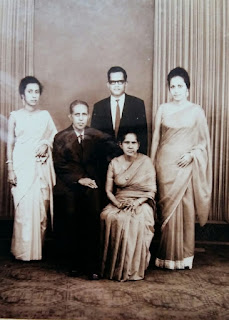
My mothers parents and eldest brother.

His son, my First cousin, is  Dr  Nandi  Wijesinghe  (Mapitiyage  Nandimittra  Wijesinghe)  He went to the US and is a V.O.G.  in  Los  Angeles. He  is  married  to  Dr  Neelakshi  Gunawardene  from  our  parallel  Peradeniya  batch,  friend  of  our batch  Manel  Wijesundera  ( Owlie).]

Speedy: Owlie, please note! Of course, you knew that Owlie!

Chira: I am sure she does. In my mother’s family, there were  4  Males and  4  Females.

 My mother’s 2nd   cousins were Prof M.V.P.  Peiris  and  Prof  S.R. Kottegoda, who was our Lecturer and later the Dean  of  the  Faculty of  Medicine, Colombo.

 Prof. M.V.P. Peiris’s father and my mother’s father were 1st cousins with the same “Ge” name.

Prof. S.R. Kottegoda’s mother  (a Wijesinghe)  and my mother’s father were  1st cousins.

Speedy: How interesting! I am sure you know that Prof Kotte’s daughter Indira is married to my younger brother Raj. They live in Sydney but are frequent visitors to Sri Lanka.

Chira: Yes Speedy, I was aware of that. Prof  M.V.P. Peiris was  an  Ambidextrous  Orthopaedic  Surgeon   who  operated   on  Prime  Minister   D.S. Senanayake. He  was  President  of  the  Ceylon  Medical  Association  (SLMA)  and  a  past Minister of  Health.  His wife Doreen  used  to  consult  me  at my consultation room at my residence, which has been functioning since 1985. 

One of Prof Kottegoda’s hobbies was Photography and he had given me a beautiful photograph of squirrels.

Speedy: Yes, he was well recognised for that. His book on Flowers of Sri Lanka is a classic.

Chira: I have seen that book. The photos are beautiful. Coming now to my first Cousins on my Mother’s side :-  

1. Late Dr Gamini Wijesinghe, Consultant  Psychiatrist  known  to  Dr Vinitha  Perera, Consultant  Psychiatrist (our Peradeniya batch)  was married  to  Late  Dr W.D.H.  Perera,  Consultant Dermatologist.

2. Dr Nandi Wijesinghe,  Consultant  V.O.G.  Living  in  Los  Angeles  married  to  Dr Neelakshi  Gunawardene ( our Peradeniya Batch )  a  friend  of  Manel  Wijesundera.

3.  Dr Anura Samaraweera  was  living  in  California  and  now  back  in  Sri Lanka. He  is known to  Lalantha Amerasinghe  as  they  had  worked together at  Palali  Army  Camp  during  the  war 

Speedy: Thank you, so many interesting connections. What about your Father’s family?

Chira:  My  father’s  father died  when  he  was  14  years old.  It was his uncle G.D.A. Abeyratne, mentioned below, who looked after him.

My father’s mother was Lucy Perera (housewife). She was a lady who always wore long skirts down to the ankles, at home.  When we were  very young  my  brother,  sister and  I  used  to  play cards  with  her, and always win, with hints off the reflection  of  her  cards  on  her  spectacles!

Speedy: Isn’t that cheating!

Chira: Well, I suppose so but don’t you think we were clever too!

Speedy: Ok, I shall grant that.

Chira: Thank you. This photo shows my father and family; my father’s mother, wearing a long skirt and my father is standing next to his sister.

Speedy: I am glad you are showing these photos as it reminds us of the type of attire in those days; a good lesson in history.

Chira: I am glad you think so. You would have noticed my mother’s mother too wearing a long skirt in the earlier photo.

My father’s sister’s son is  Dr Nihal Munesinghe  mentioned  below.

Mentioned  below also, Dr Mahima Mallawaratchi’s father (youngest in the family who changed his name from Perera to Mallawaratchi their “Ge”name )  is standing on the extreme left. He wanted my father and other members to change the name. My mother had said that people will call her by both names and didn’t like it. Then all the family members decided to name their offspring Mallawaratchi. That is how my family members and all my first cousins are Mallawaratchis! 

Speedy: This has been the experience of so many families. Ranjit Dambawinna for example was a Perera and  he  took his “ge” name, Damabawinna.

Chira: My  father’s  mother’s  younger  brother  was  Ganewattage  Don  Alexander  Abeyratne, who  got  his  M.A. from  England, (after getting there by sea).  He was  the  1st  Principal  of  Vidyartha  College,  Kandy  and later  Dharmaraja College,  Kandy.

Speedy: That is another thing which people forget. Travel by sea to England was the norm in those days.

Chira: That is true. These days of course, Air travel is the norm.

His  daughters   (My father’s first cousins) were:-

1. Hema  Jayasinghe (nee Abeyratne)  was  Principal of Visakha  Vidyalaya, Colombo. Later Deputy Director,  Ministry of Education.

I  mention  this  as  quite  a number  of  our  batch  mates (both  Colombo  and  Peradeniya) studied  at  Visakha  Vidyalaya.They are  Manel Wijesundera,  Late Priya Gunaratne, Manil Hettiaratchi,  Surangani, Sujatha Maligaspe, Kusuma, Late Kamali, Neelakshi, Chula, Chitra, Late  Srimathi.                                                                           

2. Chitra  Abeyratne  was  Principal  of Anula  Vidyalaya,  Nugegoda  and later  Principal of Musaeus  College, Colombo.

Lalani, Nisha and Padmini had studied at Anula Vidyalaya, Nugegoda.

3. Late Rani  Kitulegoda  (nee  Abeyratne)  was  headmistress  of Anula  Nursery. My son and my sister’s daughter attended Anula Nursery when she was there.

4. Nalini Kappagoda (nee Abeyratne) Consultant Pathologist, was  married  to  Late Dr M.B. Kappagoda,  Consultant  Eye Surgeon, living in Sydney,  Australia. I met them when they came for the S.A.A.R.C. Eye Surgeons’s  Congress in 2000 in Sri Lanka. I met her again when I went to Australia in 2006.

His  son   (My father’s  first  cousin), the Late  Chandrabanu  Abeyratne, who was a  Major  General  in  the  army  was  married  to  late Shiromani  Seneviratne, Dental Surgeon. Shiromani studied at Methodist College and was one year senior to me.  Our batchmates from Methodist  College  will  remember  her.

My  first Cousins  on my  Father’s side are:-

1. Dr Nihal Munasinghe  who is from  the  1st  batch  of Medical  Faculty,  Peradeniya,  built  Medicare  Hospital,  Campbell  Place,  Borella. He is known to our batchmates  from  Peradeniya. I channelled and did surgery there.  Our batchmate, Dr Drahaman had practised there as well.

2. Dr Mahima Mallawaratchi, is a Physician  living  in England. Her brother Mahesh ( from  STC ) owns  Malkey  Rent  a  Car at  Pamankada, Colombo.

Speedy: That was most interesting. Let me ask you now to talk about you and your own family.

Chira;  Thanks, Speedy. I  started  my  education  at  The  Girl’s  High  School,  Kandy  and  I  was there till the  2nd standard. I won the Class Prize that year. I also obtained a Certificate stating Very Good for Painting from The Royal Drawing Society, UK, when I was 8 years old.

Speedy: Well done Chira!  I can see how early in life you showed your artistic talents!

Chira: Thanks Speedy. But I started painting only a couple of years ago. My father came to Colombo on transfer.   I attended St. John’s Girl’s School Nugegoda for one year.

Speedy: I remember that as we lived in Nugegoda in Melder Place at that time too. (On the left, a photo of the entrance to Melder Place now)

Chira: Yes, I remember you and your sister Nelum and brothers Daya and Nihal. We used to play a lot together and had a lot of fun.

Speedy: We certainly did. We touched on this in a previous episode.

Chira: Yes we did. After that I moved over to Methodist College, Colombo. I have gone up to the stage to receive ‘A’ reports from the Principal Miss Robins on many occasions. I won many prizes at Methodist College including Rosemary de Alwis  Memorial Prize. Rosemary was a cousin of Bora’s.

My Parents and the three of us lived at  No.  6  Melder  Place  Nugegoda after we came from Kandy.


(This Family  Photo was taken in 1968)  
Speedy: How many brothers and sisters have you got?

Chira: I am the eldest of three. My brother D.P.Mallawaratchi Studied at St. Thomas Prep and St. Thomas College Mt. Lavinia. My sister  Dhammika studied at the same schools as myself.  She is married to Ranjith  Ekanayake, retired Brigadier in the Army.

Speedy: I remember both well. We called your brother Matchchi.

Chira : Yes, that’s him. That was because I couldn’t pronounce Malli properly when I was very small and the name got registered! Dayalal obtained his BSc. from the Engineering Faculty, Peradeniya,  MASc. (Master of Applied Science)  from  The University of British Columbia, Vancouver,  Canada.   A  Civil  Engineer. He was a President of  the Institution of  Engineers. He married  Prof. 


Channa Ratnatunge’s sister  Malini  MSc, Graduate worked at the  C. I. S. I. R.

My  sister and  I studied  at  Methodist  College  Colombo and travelled to school in a private car owned by Mrs. Wijewardena.  The  Vanguard  picked  us  up  from  Melder Place  and  on  the  way  picked  up Swyrie and  her 3 sisters Gemini,  Ramani  and  Preethi from  Kirillapone. Later my Father arranged a  school bus which started from the top of  Melder Place, Nugegoda. 

Swyrie and her 3 sisters also travelled in it to Methodist College.   A small girl called Noeline living at the top of Melder Place too joined us. She was teased by tying her Schoolbag to her plat, and guess who the culprit was?  Swyrie !


Speedy: And now let us talk about University and medical education

Chira; I  entered  The  University of Colombo from  Methodist  College, for a 6  Months  course  in  Zoology . Ours was the  last  batch  to follow  this course.   Sura,  Sunil, Bora, Sanath, J.C.. Patas, Senerath, Bertram Nana, Lucky, and Cassim also followed this course.

For the  Zoology  course,  we  had  only  two  lectures  and  a  practical  class every  week.  I  used  to  play Bridge  with  my  friends  Vinodhini  Chanmugam  and  Jemima  Jesuant, (both  from Methodist College) from  the  Science  Faculty. 

I  met  them  in  England  later on  when  I  went for  my  Postgraduate studies. I   visited Jemima’s  place  in  Hong  Kong  in  2008.  Sadly, they are both no  more now.  Those from Methodist College  will  remember  them. I  used  to  play  Badminton   and  represented  the  Colombo  University.  We   played against the Peradeniya  University  and won  the Tournament in 1961.  I played mixed doubles with my brother (from the Engineering Faculty) as well, during that period.

Speedy: This is news to me. I had no idea that you were good at Sports!

Chira: Well, now you know! Only Badminton and Table tennis. ( not in school)

The other memory I have of that time is how after  I entered Medical College I used to travel in a Private car with Late Priya Gunaratne, Late Kamini Gunawardene and Padmini Gunawardene .


(Photo  in  Signature Book  Medical Faculty 1962)

I  studied with Manil Hettiaratchi, Primrose and Nisha. Lalani and Padmini used to join us.                                                                     

My studying was made difficult because I  used  to  get  severe  Migraine  headaches  But  my wonderful mother helped me by reading  my  Text  Books  and notes to me. I  used to lie  down on  bed,  close my eyes  and  listen  to  her.  She was a Tower of strength to me.

Speedy: I am sure she was. We must never ever forget the love and guidance we received from our parents.

Chira: I quite agree Speedy. In my final year, I stayed at the Women’s Hostel down De Saram Road, Colombo. Pram and Dole (Piyaseeli Dolawatte) were in the next room and Manel (Owli) was in the opposite room on the 2nd floor.

Speedy: For reasons unclear, the hostel was known to us as the Hopper House!

You then graduated with the MBBS and started your internship, right?

Chira; Yes, that is correct, and no comment about the name!

My first appointment was with Dr Misso, Surgeon at the General Hospital, Colombo.  Swyrie  and  Zita  also worked with me.

Speedy: I was HO to Dr Misso too but he retired during that time and I completed with Dr Burhan or Dr DFDS Gunawardena, I can’t be sure.

Chira: Dr Misso was a thorough gentleman but I remember that time for another reason; because of a gruesome incident. I received a call from ward 1   G.H.C. saying that a man was hanging from the roof.  It was a  terrible sight to see this man who had undergone a  prostatectomy a  few days before.  I was “on-call” and had to face a number of inquiries into this incident.

Speedy: What a scenario for a young doctor to face!

Chira: It was awful. I had good friends who supported me. During this appointment, I  shared a  room with  Pram in the quarters above the  Radiology Department  GHC.

My second Appointment was with Dr Rajanayagam V.O.G. at the Castle Street Hospital for Women. Colombo. Bernadette  used  to  share  my  room  in the quarters  when  she  was  on call.

Speedy: Any other notable events you would like to share with us?

Chira: I was Bridesmaid many times. The first time was to  Anoja Wijesekera,  my  oldest  friend  from  Methodist College since  standard  4.  She married Dr Nanda Atukorale  Dermatologist, who is sadly no more The second time was  to Primrose and the third  time was to  Piyaseeli  Dolawatte (Dole). There was a saying, “third time  a bride’s maid,  never a  bride”, but  I  broke it,  and became  a  Bride  in  1979  after  I  returned  from  Overseas Postgraduate leave! 

Speedy: Good for you Chira! Old wives tales I call them.

Ok so you did your internship and then, what followed?

Chira: After Internship, my first appointment was at The Homagama Hospital.  Late Sardha too worked with me.

This was a milestone for me as I bought my first car and used to drive to Homagama Hospital.

Speedy: Your first car is something you never forget. Mine was a Triumph Herald which I bought from my brother when he went to England. I was so chuffed and proud of it.

Chira: Yes, I was so thrilled when I got it. Let me related an interesting story about my car. One day when driving to the hospital there was a traffic block, there was no movement of vehicles towards Homagama at all. Suddenly a man opened the rear left door and got into the car. I got the shock of my life!  I didn’t know how to get rid of this man. He offered to show the way to the Hospital via a side road. He got me to turn the car to the left and as we proceeded a fair distance, I saw a hospital attendant standing at a bus halt. I stopped the car, thanked him for his help and told him that there is a person from the hospital that I could go with him. I heaved a sigh of relief! Ever since that day I used to lock the car from inside.                                                                                  

Speedy: What a story! You must have been scared out of your wits!

Chira: I was and still shudder when I recall it.

Speedy: And what was next?

Chira: Next was my Eye Hospital appointment, from May 1971.  I   worked with Late Dr Velauthan.    Kusuma had worked at the Eye Hospital just before I went there. 

Vasantha Ovitigala worked with me at  Eye Hospital. I went to see Vasantha’s first baby with Benita Stephen (Thoracic surgeon’s wife), when they were living down Kynsey  Road, Colombo.  Vasantha is married to  Karu Jayasuiriya. (former Speaker)  That daughter married  Naveen  Dissanayake, Gamini Dissanayake’s  son.                                                                                                                                  

Speedy: The next stage is your postgraduate career and how you became such a well-known and respected eye surgeon in Sri Lanka. Please take us through that period

Chira: Thanks for your kind words Speedy. I left for the U.K. at the end of February 1976 on No Pay Study Leave granted by the Government to do the Diploma in Ophthalmology and the FRCS in Ophthalmology.

I was allowed only 3 Sterling Pounds and 10 Shillings exchange on my Passport. I was not given any allowance from the Government. I had to earn my own living and study on my own all by myself. There was absolutely no teaching or any guidance and nor any advice given to me as to how to set about studying for these exams. I had to ask others and study, A Herculean task!

I told my daughter Anjali who just passed her local Final M.D.Ophthalmology exam. that she is very lucky that her training was excellent for a period of 4 years with 4 exams. They were given Lectures; Clinical Lecture Demonstrations and periodic assessments and Workshops conducted by our College of Ophthalmologists which helped them. They did group studies as well. In contrast, for me it was a case of self-study without any group studies and no training at all. I also had to earn my living in UK.

Speedy: That was the norm for no pay study leave which I too went through. You were set afloat in a foreign country with hardly any resources, clutching references received form your bosses and had to use all your ingenuity and skill to navigate and finally reach the shore with that much-wanted qualification. It was a case of triumph for optimism over fear.

Do carry on Chira. I couldn’t help reflecting on that time period.

Chira: I couldn’t agree with your more Speedy. Talking of what happened after I went to U.K., I first worked as a Clinical Assistant  at Moorfields Eye Hospital London and Western Ophthalmic Hospital London. I passed the Primary FRCS in 1976.  

Next, I worked  as  SHO Ophthalmology, at The  London  Hospital,  Whitechapel   England. I  obtained  The Diploma in Ophthalmology in 1977.  (D. O.  Lond)

I was SHO Ophthalmology  in Sutton General Hospital when I obtained the F.R.C.S. (Eng ) in 1978 and worked as Registrar at the Royal Surrey County Hospital Guilford, England and came back to Sri Lanka in May 1979.                                                    

I was  in  the U.K. for  3 years and 3 months. I used to visit Pram in Wembley and later in St. Johns Wood,  Manil Hettiaratchi in  Blackpool and later in Dulwich,  Wimala Sothinadan (de Silva) in Colchester. I visited Bernadette in Wakefield, Primrose in Kent and later Granthum and  Zita in Southend-on-Sea.

Speedy: After gaining all your qualifications, you came back to Sri Lanka. Take us through your next phase.

Chira: Yes, I came back to Sri Lanka in May 1979 and was appointed   Consultant Eye Surgeon  Kegalle Hospital.  When  Cassim got a transfer to Eye Hospital from Kandy Hospital, I got a transfer to Kandy Hospital in Oct 1979.

Speedy: We just missed each other as I came back to England in April 1979. I was the first Consultant Neurologist in Kandy from December 1977 and set up the Unit from scratch.

Chira: That was great! It is a pity that you had to go back to England but I know you had good personal reasons to do so.

Speedy: Thanks for your understanding Chira. I gather you married in that time?

Chira:  Yes, I got married to Ranjit Jayaweera Bandara in Oct 1979. He did Geography Honours at the Peradeniya Campus. He went to UK and obtained the Charter in Personnel Management.  He worked at the C.I.S.I.R. and later at the State Mortgage Bank Colombo, as A.G.M. He did the LLB at the Open University and worked as a Legal Adviser to the S.L.I.I.T. Colombo.

Speedy: And your next jobs in Sri Lanka? 

Chira: I worked in Kandy Hospital for 5 years. Dr Reggie Seimon was the other surgeon there. I came to Eye Hospital Colombo as Consultant Eye Surgeon in Oct 84 and retired in Feb. 2001.

Speedy: Any special memories of that time?

Chira: Not a pleasant one Speedy. I was in the  Operating  Theatre, Eye  Hospital when the Central Bank Bomb blast occurred in Jan. 1996. Many casualties were brought. Prof Sheriffdeen wheeled in Mr Lalith  Kotelawala with cut injuries all over his body mainly the upper part including his eyes. I started suturing him and Dr Saliya Pathirana (Retinal surgeon) took over as his retina was involved.

Later Mr Lalith  Kotelawala  built  The  Golden   Key  Eye  and E.N.T. Hospital,  Colombo.  Dr Saliya  Pathirana is  in charge  of the  eye department.   

Speedy; You developed special expertise within Ophthalmology. Tell us about that.

Chira: I went with other Consultants to Hyderabad and Madras to follow workshops on Cataract Phaco emulsification  Surgery in 1999.  Cassim also joined. This is the latest  technique to remove a cataract by emulsifying the cataract and  sucking it out with the  Phaco machine. 

Speedy: You had several spells in the UK after you became a Consultant. Where and when did you work?                                                       

Chira: While working in Govt.  Service  we  were  entitled  to  take  6  months overseas  leave  every  5 years. I made use of this and  worked   in  the U.K in the  latter  halves  of  1986,  1992  and  1998.        

Speedy: You have some special memories of Wales Chira. Tell us about it

Chira: It happened like this. In 1992,  I worked as Locum Consultant Ophthalmologist, Isbity hospital, Gwenedd, Bangor North Wales.  While I was there, Ranjit and the two Children came  to  Bangor, North Wales and spent 3 months with me.   My children went to school in Bangor and they even learnt the Welsh language! The other memory of that time is that Primrose, Upul and children  came  to  Bangor North Wales and spent a weekend with us.  We visited  Anglesey with them.

Speedy: I see. Must have been great to have them. I gather also that you gained some more special experience in the UK?  

Chira: Yes Speedy, it was so nice to be with them About my special experience, when I went to U.K.in 1986,  I  learnt  the use of the Laser and obtained experience in  Laser treatment..

At that time Sri Lanka did not have a single Laser machine. When I was the President of the Ophthalmological Society of Ceylon in 1987I started a Laser fund. I organised several   Programmes to raise funds. 

Speedy:  That was great! What sort of fundraising programmes were they?

Chira: Different sorts, some of them were T.V. and Lion’s  club programmes.

And also working in UK in 1992 and 1998 as a Locum Consultant, I gained experience with more modern and advanced instruments and techniques which helped me to purchase certain items and improve my techniques in Sri Lanka.                         

Speedy: I think that system of granting postgraduate leave was mutually beneficial. It motivated the doctors to enhance their knowledge and expertise, and at no real cost to the Government. It also gave them and their families an opportunity to visit other countries.


What an incredible journey Chira! Now I would like you to sit back and relax and talk about your own family.

Chira But of course! Is it Ok if I have my cup of tea now? Do please help yourself too. Hope it has not gone cold.

Speedy: Of course Chira, please do and thanks for my cuppa too.

Chira: You are most welcome. 

Coming to my children, I have two and they are both doctors. My son Anju studied initially at St. Thomas Prep. Kollupitiya and later at Royal College, Colombo.

Speedy: I didn’t know that! How interesting because I too went from St Thomas Prep Kollupitiya to Royal College.

Chira: There you are! He then studied Medicine, like you too! But at The Kursk State Medical University, Russia (in English). He is currently working as M.O. at the National Hospital, Colombo in the Orthopedics Unit.  He is interested in Photography and is now a Professional photographer doing weddings etc. as well.

My  Daughter Anjali  initially studied at  Methodist College, Colombo and later at Visakha Vidyalaya, Colombo. She studied Medicine at the Kasturba Medical College, Manipal, India. She passed her Finals M.D. in Ophthalmology in January 2021. At the moment she is working as Senior Registrar at the Eye  Hospital, Colombo.

Speedy: You must be so proud of them, and rightly so. It is even more interesting after reading Sanath Lama’s recent post on Medical Education. Your experience is a good example of how private medical education (cost borne by the parents), have benefitted Sri Lanka.

Speedy:  Chira,   How about grandkids?

ChiraMy son has a 9-year-old son and a 4 year old daughter. (photo of them as kids)

Speedy:  They must be a hand full.

Chira:  Yes, they are very naughty. They are living down the lane and I am very busy babysitting them very often especially these days because of Corona outbreak and no schooling.

Thank you for sharing your journey with us Chira. Before we finish, I hope you won’t mind doing a follow up where I like to discuss not only your achievements in the field of Ophthalmology but your achievements at the Eye Hospital, and perhaps some more drawings too?

Chira: Yes, I am quite proud of my achievements and as for drawings. I am very happy to oblige.

Speedy: That’s great! I shall give you a little break and invite you again soon.      

Chira: Thanks very much Mahendra- I have slipped back to Mahendra! Hope you don’t mind.

Speedy: Not at all Chira, after all, you knew me as Mahendra first! Who would have guessed that the two of us who were kids in Nugegida would end up as Batchmates. As Nhial would say, it is the "awesome force of destiny"!

That was fun! I enjoyed this session a lot. It will also, be a kind of flashback of their own lives for many who will surely read and enjoy this with some degree of nostalgia.

Chira: Thanks Mahendra, I really enjoyed it too. You have taken a lot of trouble and I appreciate very much your effort.  Thank you for giving me this opportunity and I hope that the Blog will continue to flourish. All the best!

Speedy: It has been my pleasure and thanks again for sharing.