Saturday, January 14, 2017

Diatoms of England

Zita has sent in this article written by her friend and former colleague Michael Stringer, who, in addition to his interest in ophthalmology, has a myriad of other interests like photography, geography, sport, and a serious interest in the subject of ‘Diatoms’.  She feels  (and I agree) that our viewers would  be interested to learn about this organism and also read more about it from the references given.

There are many topics that you are already familiar with, The Rose of England, The Queen of England, The Garden of England and even The Heart of England.  So, I hear you ask, what is / are The Diatoms of England?


The UK has been defined as a group of islands made of coal and surrounded by water.  There is a lot of water everywhere in England.  We even classify our bodies of water!  We have Bogs; The Fens; Marshes, Ramsars and so on.   There are little treasures, such as The Norfolk Broads,  The Lake District and the Somerset Levels.  You mustn't forget all the Coastline, Estuaries and mud flats, either.  My interest is the tiny island Two Tree Island, between Leigh on Sea and Canvey.
Water is very important in this little discussion we are going to have, because it is the home of The Diatom and they are not fussy what type of water it is.  Some are adapted to  Marine, Fresh, Brackish, damp soil, mosses, bogs, aquariums, puddles and even dripping taps as long there is access to the sky and sunshine.

Now, we will look at just what a fascinating and beautiful critter the diatom is.  OK, it is a tiny plant, but it is the only shelled plant. It has a shell made from silica – glass – and when photographed against a black background and suitable lighting, they are, truly, exquisite.  An humble Algae but when you have watched these simple cells dance; spin; glide; turn somersaults,  you would believe they are tiny critters.  One, I experimented with, moves at 5 metres a second – that is half the speed of Usain Bolt,   So, now, we have plants that can move and some are quite sprightly.  If we scale up their size to ours, we would have a tough job keeping up with them.  They are not Ents, or Triffids.  They give an estimated 45% of the oxygen we breath and sit at the bottom of the food chain.  They are prime providers and producers.

Check out Wiki on this link http://en.wikipedia.org/wiki/Diatom for more technical bits.  While there, look at the photomicrograph of Marine Diatoms at this link ..           http://en.wikipedia.org/wiki/File:Diatom2.jpg .

This, I believe endorses my description that Diatoms are beautiful.  The shapes, intricate designs within these shapes and their colours, are stunning.  There are quite a few to collect and study; modern thought indicates there are about 150,000 named species Worldwide and about the same number again waiting to be named.  Locally, there are over a thousand species.

 Diatoms are a unique source of oil as well as all their other contributions and I have a friend in India, who have no natural reserves of this valuable commodity who is conducting experiments to breed Diatoms to extract their oil. The petrol you put into your car originates from Diatoms that they produced a few million years ago.

 Because my study is over a very small area, the richness of the colony is very large. I do not even have the time to do a serious study of the Freshwater species, nor the Brackish species that live in the numerous lagoons.  The richest site would be the Bird Reserve at the West of the island.  It is a Site of Special, Scientific Interest – a SOSSI …  I would love just a couple of netfulls of the mud from that site.  The guano from all the visiting birds would be incredibly rich in Diatoms, many of which have arrived from thousands of miles away.  I think this is why, in 2006, I discovered the rarest plant in Europe.  The Pallidum usually lives in the sea off Japan, although, in all honesty, I know of no birds that migrate from these distant shores to Essex.   It was still resident in October 2016.


Head to tail, X 6,  is 1 mm.   Not only do Diatoms bring fame, they can also bring a lot of prestige among fellow scientists.  In 2016, The European Microscopy Congress, held in France, chose one of my pictures to adorn all their literature, banners, advertising – even the Banquet menu, www.emc.fr .  It is a study that has also brought in a few pennies – 2008 I was fortunate to win the Nikon Small World competition.  This is the Oscars for photomicrographers.  With thousands of pictures from Universities, Institutes, Commercial, Professional and Amateurs a handful of Diatoms from Two Tree Island, took the prize. 

 Diatoms are fascinating to watch live as they dance and play but their colour shape and form when they are dead is truly stunning.  I have a dear friend who has the amazing skill of creating exquisite arrangements of these little jewels, by hand. Believe it, or not – one of the sharpest points in Nature is a Pig's Eyelash!  An eyelash is glued to a needle that is glued to a pen holder. Using this, he carefully picks up a diatom from one slide – swaps slides and carefully re-positions onto a suitable adhesive, in the desired place.  Once complete, the slide is finished off with a mountant and cover slip and he sells them for a lot of money!  Here are just a few he made for me with diatoms from Two Tree Island.  I will leave it to your Editor how many are printed!  Enjoy my passion for Nature's most exquisite little shelled jewels...


Friday, January 6, 2017

Block Seniors vs Staff Cricket match - circa 1963


The match was played at Campbell Park. I still remember very clearly what Anton Ambrose was muttering in his drunken state. I don't want to repeat them here! Note the near 100 per cent turn out. I tried to enlarge the photo, but as I do so, clarity is lost. Most of the staff members who are seated here are no longer living.

When we were 53 years younger!


I projected some of these in my powerpoint presentation at the last Reunion. But as we approach our 50th Anniversary, I thought of sharing them once again.

As most of you know, I have been sending daily updates on the Reunion only to those who have confirmed attendance. 

These are from our 2nd MB trip and the Block Seniors-Staff cricket match. 


“Marker” and the Men’s Common Room

By Lakshman Abeyagunawardene

As a medical student in the sixties, like many of my colleagues, I spent most of my free time in the men’s common room. Apart from indulging in most of the indoor games, regular users of the facility read newspapers and magazines that were available. Others simply sat in the comfortable chairs sipping tea, smoking cigarettes or chatting with friends. A few members of the staff including Professors Ranasinghe, Viswanathan, Milroy Paul and Navaratne, used the common room as a short cut to get across from the car park to the canteen or the main staircase in the foyer. No less a person than the Dean Professor Abhayaratne himself, paid that occasional visit while the University Medical Officer Dr. E.H.C. Alles was often a keen spectator at an ongoing game of bridge.

There was hardly a day that I missed a game of billiards. The billiards table was placed in one corner that was closest to the Clock Tower. The adjacent windows opened out to Kynsey Road where the main entrance to the Administration Block of the Colombo Medical Faculty is. On some days, there was a mad scramble to get at the all important red monitors exercise book which was kept in the custody of “Marker” overnight. The struggle was to book a half hour game of billiards which cost 30 cents. The session most in demand was at noon during the lunch hour.

The man in charge of the billiards table was better known as “Marker”. But his real name was Ranasinghe.  More often than not, he was already there in the mornings when students started arriving. The rush to book a game was on days that “Marker” arrived late. He travelled daily by train from a village called Galahitiyawa in Ganemulla. From the Maradana Railway Station to the Medical Faculty was a brisk 15 minute walk for him.

I have no idea as to how long “Marker” had been in this job. He was there when I entered in 1962 and continued for some years even after I graduated in 1967. In the first few years that followed, I made it a point to drop in at the common room whenever time permitted. On such occasions, I never failed to have a chat with “Marker”. But I have not done so for decades and contact with “Marker” was lost, maybe forever.

“Marker” was an enterprising individual. He made a little extra money on the side by selling items of stationery. He also sold cyclostyled notes that came down generations of medical students. Surgery notes in particular were much in demand.


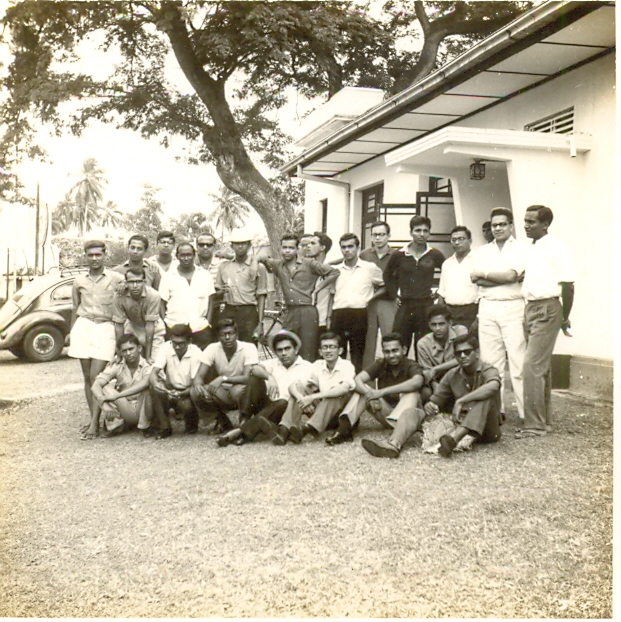
Each year when the traditional Final Year Trip came around, “Marker” was invariably in the bus. In the accompanying picture that was taken in Badulla during our Final Year Trip in 1966, the figure clad in sarong on the extreme right is “Marker”.


Lesser known characters from our Medical Faculty days

By Mahendra Gonsalkorale.

Quite understandably, many of the reminiscences that have featured in our Blog concerneither our fellow travellers or our Teachers. I want to talk about a few of the “less mentioned” who also formed an important part of our faculty experience. I shall start the ball rolling by recallingArumugam from the Anatomy Department,  “Prick”Perera from Physiology and Rogus from Pharmacology. There are of course many more and I do hope that other readers will chip in with their own stories.
Arumugam, if I recall correctly, was a shortish and somewhat malnourished figure in khaki shorts or tucked up sarong showing signs of balding with a mix of black and grey hair combed back. He displayed a moustache and possibly a rather sparsely populated facial “fungus”. He had his front teeth peeping between his lips most of the time although he never smiled. He was a bit hunched and smelt of formalin. I am certain he was fond of alcohol. He was “in charge” of the dissecting labcontaining rows of cement slab tables on which corpses were dissected by us. I recall approaching him to provide a group of us with a brain preserved in Formalin for dissection at home. He readily obliged for a small santhosum. I always wondered whether he had a hidden dark side dealing with more macabre matters.

Prick Prerea, bespectacled with a prominent bald forehead and receding black hair was always dressed in white with his trouser waist band just inferior to his nipple line.He looked busy all the time, and had that cultivated air of importance. When I met him first, Ithought he was a Lecturer or Staff member.  He sensed thisbut did little to put me right. He certainly was the Lord of the Jungle as he strutted round apparently doing all kinds of important things when not pricking fingers and drawing blood.To me, he never smiled or looked  happy.

Roguswas quite a character. White traditional sarong with wide black belt, betel stained teeth and ever present smile, he was Prof Kotte’s and Dr Lionel’s “all-purpose man”. He would tidy up, shop, run errands and do any odd jobs around the department.  I got to know him quite well when I returned to the Pharmacology department as a Demonstrator in 1972. He was so obliging, willing to help in any way he could. He had some unpleasant duties too, such as provide cats for demonstrating the pharmacological effects of various chemicals on the circulation which sadly meant sacrificing the unfortunate creatures. I do hope that this unnecessary experiment is no longer carried out. Rogus once invited Dr Lionel, myself and other members of the Department to visit his home and he proudly provided us with a delicious meal consisting of manioc, grated coconut and lunumiris, apologising that he could not offer anything grander and thanking us for coming to his humble abode.


As I said,  there were many more in all the various Departments and I do hope some of you will come up with more recollections